
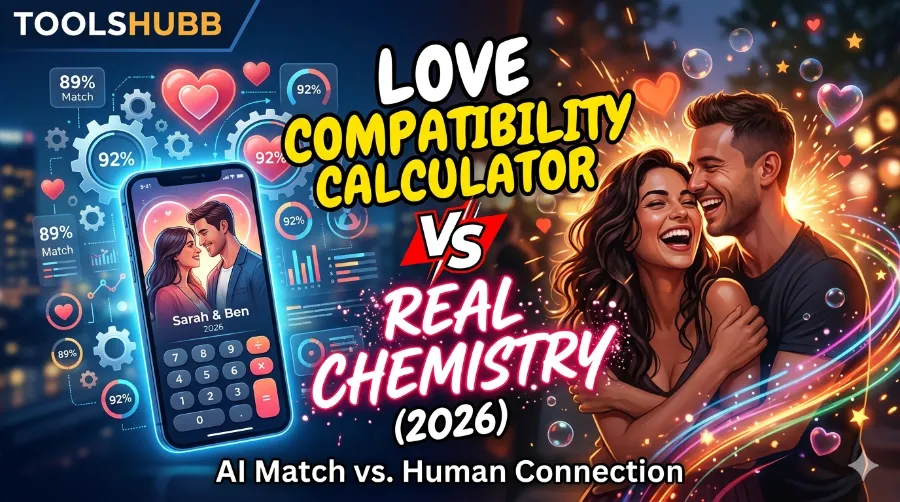

You type in two names. You hit “Calculate.” A number pops up 87%, 64%, maybe a heart-stopping 99%.
For a second, that number feels like it knows something. But does it? Or is the spark you felt across the room last Friday the only “score” that actually counts?
In 2026, love compatibility calculators are more popular than ever AI, astrology, numerology, and personality science now drive them, and millions of people share their results across TikTok and Instagram. At the same time, dating coaches keep repeating the same warning: you can’t fake chemistry, and compatibility on paper doesn’t guarantee a connection in real life. need counseling then you are right place.
So which one should you actually trust? Let’s break it down.
You can check you love score, zodiac compatibility and dating tips through other our services
What Is a Love Compatibility Calculator?
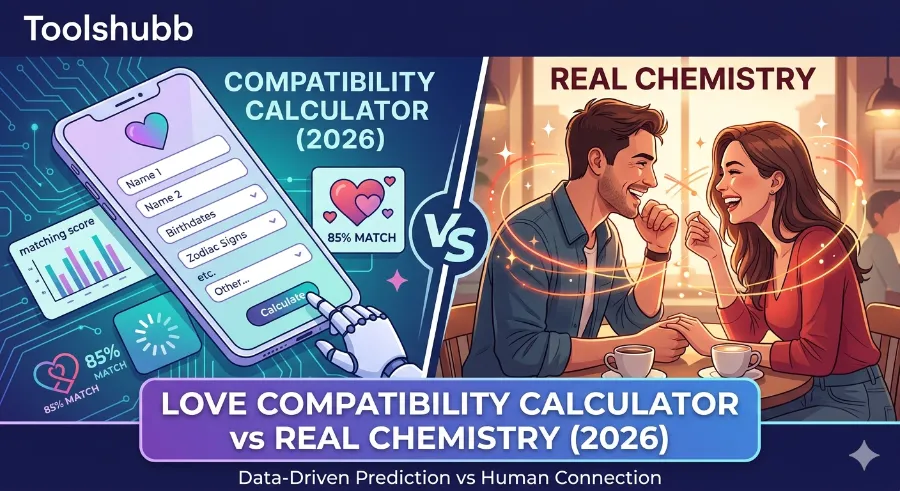
A love compatibility calculator is an online tool that takes inputs usually two names, birth dates, zodiac signs, or personality quiz answers and runs them through an algorithm to produce a compatibility percentage or score.
Most calculators fall into one of these categories:
- Name-based calculators: use letter patterns, numerology values, or fun algorithms (often more entertainment than science)
- Zodiac/astrology calculators: compare sun signs, moon signs, or full birth charts to estimate compatibility
- Personality based calculators: use frameworks like the Big Five, attachment styles, or love languages to compare two people’s traits
- AI powered relationship calculators: the newest 2026 trend, where AI analyzes quiz responses, communication style, and even chat patterns to generate a compatibility report
The appeal is obvious: it’s fast, fun, shareable, and gives you something concrete when love itself feels confusing and uncertain.
What Is “Real Chemistry,” Really?
“Chemistry” is the word we use for that instant, often unexplainable pull toward another person. Psychologists describe it as a mix of:
- Physical attraction: pheromones, facial symmetry, and voice tone all play a role
- Emotional resonance: the sense that someone truly gets you in conversation
- Neurochemical response: dopamine, oxytocin, and norepinephrine spikes that create excitement and bonding
- Shared rhythm: how naturally a conversation flows, how comfortable silence feels, how humor lines up
Unlike a compatibility score, chemistry isn’t something you can calculate in advance. It emerges sometimes instantly, sometimes slowly through real interaction.
Love Compatibility Calculator vs Real Chemistry: Quick Comparison
| Factor | Love Compatibility Calculator | Real Chemistry |
|---|---|---|
| Speed | Instant result | Builds over time or hits instantly in person |
| Based on | Names, birth charts, quiz answers | In-person interaction, body language, conversation |
| Scientific backing | Varies, some personality models have research support; zodiac/name calculators are entertainment | Psychology and neuroscience support it (attraction, bonding hormones) |
| Predictive power | Useful as a conversation starter, weak as a relationship predictor | Strong early predictor of attraction, but not of long-term stability alone |
| Best used for | Fun, icebreakers, self-reflection on compatibility factors | Gauging real-world connection and attraction |
| Risk of relying on it alone | Can create false confidence or false rejection before meeting someone | Can lead to chasing intense-but-unhealthy connections (limerence) |
The Science Behind Compatibility Calculators
Not all calculators work the same way and that matters for how seriously you take the result.
Personality based tools (think Big Five traits, attachment style quizzes, or love language assessments) draw on decades of psychological research. Studies consistently show that traits like emotional stability, agreeableness, and shared values correlate with relationship satisfaction over time. A calculator that uses these frameworks can offer a genuinely useful snapshot of potential compatibility.
Astrology and numerology based tools, on the other hand, don’t have peer reviewed research backing them as predictors of romantic success. That doesn’t mean they’re useless they can spark conversation, self reflection, and a sense of fun, but you shouldn’t treat them as scientific verdicts on whether two people belong together.
The newest wave of AI compatibility calculators in 2026 tries to bridge this gap, analyzing communication patterns, values alignment, and behavioral preferences. These can be more nuanced, but they’re still working from limited data a quiz, not a relationship.
The Science Behind Real Chemistry
Biology drives chemistry as much as psychology does. Research on attraction points to several real, measurable drivers:
- Dopamine and novelty: new connections trigger reward-system activity similar to early-stage addiction, which is why new chemistry feels so intoxicating
- Mirroring and synchrony: couples who unconsciously mirror each other’s posture, tone, and pace report higher attraction
- Oxytocin and touch:physical closeness and even brief touch can accelerate bonding
- Vulnerability and self disclosure: the classic “36 questions” research found that mutual vulnerability rapidly increases closeness, you can build chemistry, not just discover it
intense early chemistry doesn’t always predict long-term compatibility. Some of the most passionate early connections fizzle because the underlying values, habits, or life goals don’t align which is exactly where compatibility factors come back into play.
So. Which Matters More in 2026?
Here’s the honest answer: they measure two different things, and you need both.
- A compatibility calculator can highlight alignment on values, communication style, and life goals — the things that determine whether a relationship survives the daily grind.
- Real chemistry tells you whether there’s genuine attraction and emotional spark the thing that makes a relationship feel alive.
A relationship with high “calculator compatibility” but zero chemistry often feels more like a good business partnership than a romance. A relationship with intense chemistry but low compatibility can feel like a rollercoaster thrilling, but exhausting, and often short-lived.
The healthiest relationships tend to have both: a strong compatibility foundation plus real chemistry on top.
How to Use a Compatibility Calculator the Smart Way in 2026
If you’re going to use a love compatibility calculator (and honestly, most people do at some point), here’s how to get real value from it:
- Use it as a conversation starter, not a verdict. Comparing results with a partner can open up honest discussions about values, habits, and expectations.
- Pay attention to the categories, not just the score. A tool that breaks compatibility into communication, values, lifestyle, and emotional needs is far more useful than a single percentage.
- Don’t let a low score talk you out of a real connection. If the chemistry is there and the relationship feels healthy, don’t dismiss it because an algorithm disagreed.
- Don’t let a high score override red flags. No calculator can detect dishonesty, incompatibility in real life, or how someone treats you when they’re stressed.
When Chemistry and the Calculator Disagree
This is where most people get stuck and it’s actually the most useful scenario.
- High compatibility score, low chemistry: This often means the relationship has potential but needs time, shared experiences, or more vulnerability to build a spark. Sometimes chemistry grows; sometimes it simply isn’t there, and that’s valid too.
- Low compatibility score, high chemistry: This is the classic “can’t explain it, but it works” situation. It’s worth exploring — but pay close attention to whether the differences the calculator flagged (values, communication, life goals) show up as real friction over time.
Frequently Asked Questions
Are love compatibility calculators accurate?
It depends on the type. Personality- and psychology-based calculators reflect real research on relationship satisfaction, while you should treat name- and astrology-based calculators as entertainment rather than scientific predictions.
Can a relationship work without “real chemistry”?
Chemistry can sometimes grow over time as people get to know each other, especially when there’s strong emotional safety and compatibility. However, most people find that some level of attraction is necessary for a romantic (not just platonic) relationship to feel fulfilling.
Can chemistry exist without compatibility?
Yes and it often does, especially in the early stages. The challenge is that intense chemistry without compatible values or communication styles tends to create instability over the long term.
What should I trust more: the test result or my gut feeling?
Use the test result as information, not instruction. Your gut feeling especially how safe, respected, and energized you feel around someone is data too, and arguably more important.
Is there a “best” love compatibility calculator in 2026?
The most useful calculators are the ones that explain why they generate a score — breaking results down by communication style, values, emotional needs, and lifestyle rather than giving a single mystery number.
Conclusion: It’s Not Either/Or
A love compatibility calculator is a tool a fun, sometimes genuinely insightful way to reflect on what you and a partner value, communicate, and need. Real chemistry is the spark that makes a connection feel worth pursuing in the first place.
In 2026, the smartest approach isn’t choosing one over the other. It’s using a compatibility calculator to understand the foundation, and trusting real world chemistry to tell you whether that foundation has any spark on top of it.
Curious where you and your match stand? Try our free Love Compatibility Calculator above and see how your connection scores then go find out if the chemistry matches the number. 💘