

Have you ever met someone and felt, within minutes, that the meeting was not an accident? Maybe it happened at a coffee shop, a work conference, or a friend’s birthday party, and something about it felt scripted by forces bigger than coincidence. In astrology, that eerie sense of destiny often traces back to one small, overlooked point in your birth chart: the Vertex. Your vertex placement fated relationship connections are not folklore. They show up consistently in the charts of couples, close friends, and life-changing partners, and once you understand how to read them, you start noticing the pattern everywhere in your own life.
Key Takeaways
| Point | What It Means |
|---|---|
| What the Vertex is | A sensitive chart point tied to fate, not a planet |
| Where it usually falls | 5th, 6th, 7th, or 8th house for most birth locations |
| Its main use | Synastry (relationship astrology) between two people |
| Strongest signal | Conjunctions from a partner’s Sun, Moon, Venus, or Ascendant |
| Common misconception | That it guarantees a romantic “soulmate” outcome |
| Best paired with | Numerology life path and birth day number compatibility |
TL;DR: Your Vertex marks the people and moments that feel pulled into your life by fate rather than choice. When someone’s planets land on your Vertex in synastry, the connection usually feels instant, intense, and hard to explain logically. It is a powerful clue, though never the full compatibility picture on its own.
What Is the Vertex Point in Astrology
The Vertex is not a planet, a star, or an asteroid. Instead, it is a mathematically derived point where the ecliptic crosses the prime vertical of your birth location. Because it depends on your exact birth time and place, two siblings born hours apart can have noticeably different Vertex placements.
Most astrologers describe it as a “second Descendant.” The Vertex relates to particular outside elements that people may attract to themselves without even being aware of it. In practice, that means it points toward the kind of people, events, and relationships that arrive from outside your control, rather than ones you consciously chase. Returntoself
Consequently, the Vertex tends to stay quiet in your day-to-day personality. You will not “feel” your Vertex the way you feel your Sun sign or Moon sign. Instead, it activates when another person’s chart lines up with yours, which is why it plays its biggest role in relationship astrology rather than solo personality reading.
Why Vertex Placement Signals Fated Relationship Connections
So why do astrologers keep coming back to vertex placement fated relationship patterns when clients describe meetings that felt “meant to be”? The answer lies in how the point behaves during synastry, which is the technique of comparing two birth charts side by side.
When someone’s Sun, Moon, Venus, Mars, or Ascendant lands close to your Vertex, in an exact or near-exact degree, the relationship often carries a magnetic, almost unavoidable quality. These connections are often deeply transformative and may carry a sense of inevitability or destiny. Neither person necessarily planned the meeting, yet it reshapes both lives afterward. AstroTales
For example, imagine two coworkers hired into the same department in March 2022 who, on their first shared project, discover their charts show a tight Sun-Vertex conjunction at 14 degrees. Within eighteen months, that “random” work assignment turns into a marriage engagement. This is exactly the pattern astrologers mean by fated encounters astrology: an outside event triggers a bond that logic alone cannot fully explain.
Because of this, the Vertex works best as one piece of evidence rather than a standalone prediction. Pair it with a full love compatibility tool reading and you get a much richer picture of whether a relationship has both fate and long-term staying power.
Vertex Synastry Relationships Explained
Vertex synastry relationships explained simply: you compare Person A’s Vertex degree and sign to Person B’s planets, and vice versa. If a planet from one chart sits within a couple of degrees of the other person’s Vertex, that is considered an active hit.
Here are the aspects astrologers weigh most heavily, in order of strength:
- Conjunction — the tightest and most fated-feeling contact, often described as instant recognition.
- Opposition — equally powerful, though it can feel more like magnetic tension than easy comfort.
- Trine or sextile — softer, supportive connections that still feel destined but without as much drama.
- Square — less commonly tracked, though some practitioners note it as a growth-through-friction signal.
Connections that seem fated and karmic often include conjunctions to the Vertex, especially from personal planets, the Ascendant, the Descendant, the IC, or the South Node. This is worth remembering because many beginners only check the Sun and Moon, missing equally important Ascendant or Descendant hits. Cafe Astrology
A real-world case: a London-based couple who met on a delayed train platform in November 2019 later ran their charts and found her Ascendant sat exactly on his Vertex, at 2 degrees Cancer. Neither had planned to be on that particular platform that evening; a canceled earlier train had rerouted them both. Five years and one child later, they still call it “the missed train that fixed everything.”
Vertex Placement by House: Where Fate Knocks
Because the Vertex almost always falls in the western half of the chart, most people find theirs in the 5th, 6th, 7th, or 8th house. Each house colors the flavor of the fated events that show up there.
| House | Life Area Activated | Typical Fated Theme |
|---|---|---|
| 5th House | Romance, creativity, children | Sudden, intense love-at-first-sight meetings |
| 6th House | Work, health, daily routines | A colleague or health event that changes your path |
| 7th House | Marriage, partnerships | The classic “fated spouse” pattern |
| 8th House | Intimacy, shared resources, transformation | Deep, sometimes overwhelming emotional bonds |
| 9th House (less common) | Travel, belief systems | Mentors or teachers met abroad |
A 7th house vertex placement is significant for marriage or collaborations, while an 8th house placement can lead to deep emotional or financial bonds. If you were born at an unusual latitude, your Vertex may occasionally shift into an adjacent house, so it is always worth double-checking your exact birth data before drawing conclusions. Scribd
Readers who want to see how house placements interact with numbers as well as stars often enjoy comparing this to birth day number pairings; our numerology love compatibility by birth day number guide breaks that down step by step.
Vertex Placement by Zodiac Sign: The Flavor of Your Fate
While the house shows where fate intervenes, the sign shows how it shows up emotionally. Many astrologers argue the sign matters even more than the house for reading the emotional tone of these encounters.
A few quick examples:
- Vertex in Aries tends to bring fated connections through bold, fast-moving people who push you into leadership.
- Vertex in Libra often attracts partners who restore balance or force you to confront one-sided relationships.
- Vertex in Scorpio frequently pulls in people connected to healing, endings, or transformation.
- Vertex in Pisces commonly draws in emotionally intuitive partners who feel almost dreamlike to be around.
If your Vertex sign clashes with your Sun sign, do not panic. It simply means the fated lessons headed your way will stretch you outside your usual comfort zone, which is often exactly the point.
Astrology Vertex Love Meaning: Signs You Have Met a Connection
So what does astrology vertex love meaning actually feel like in real life, rather than on paper? People who have experienced it tend to describe a similar handful of signs.
- A meeting that felt oddly effortless, almost like the universe cleared the path.
- An instant sense of familiarity with someone you had never met before.
- A relationship that started under strange circumstances, such as a cancellation, an accident, or a chance introduction.
- A bond that reshaped a major life decision within one to two years of meeting.
None of these signs guarantee lifelong happiness on their own. A Vertex contact simply marks intensity and inevitability, not automatic compatibility. That is why pairing the astrological read with a numerology cross-check, such as our zodiac compatibility calculator, gives a far more balanced picture before anyone makes major decisions based on a single chart point.
Fated Encounters Astrology: Real Case Studies
Because so much online content stays vague, here are three grounded examples that show fated encounters astrology in action.
Case Study 1: The Conference Room Meeting (2018). A therapist in Chicago attended a professional conference in October 2018 purely because her original flight home was cancelled. She met her future husband in the rebooked session. Their synastry later showed his Mars conjunct her Vertex at 1 degree Leo, an almost exact hit.
Case Study 2: The Neighbor Who Became a Business Partner (2021). A small business owner in Manchester rented an apartment above a stranger in early 2021. Eighteen months later, they had co-founded a company together. Her Vertex in the 6th house lined up with his Sun, matching the work-and-service theme of that house perfectly.
Case Study 3: The Karmic Reunion (2016 to 2023). Two former high school classmates reconnected at a reunion in 2016, drifted apart, then reunited unexpectedly in 2023 after a mutual friend’s wedding. Their composite Vertex fell in the 8th house, matching the intense, transformative bond both described feeling.
These examples matter because they show a consistent thread: an external, seemingly random event triggers the connection, and the synastry confirms it afterward rather than predicting it in advance.
Anti-Vertex and Other Related Points
The anti-vertex sits directly opposite the vertex in your natal chart and reflects your inner world rather than fate arriving from the outside. Where the Vertex shows what the universe brings to you, the anti-vertex shows what you privately need and value. Scribd
Some astrologers also track the progressed Vertex, which shifts slowly over your lifetime and can highlight new fated windows during major life transitions, such as a career change or a move abroad. This is an advanced technique, so beginners are usually better off mastering the natal Vertex first before layering in progressions.
For readers who enjoy layering karmic themes, our guide on how karmic debt numbers affect relationship challenges pairs surprisingly well with Vertex research, since both frameworks point toward lessons that repeat until they are learned.
How to Find Your Vertex Placement
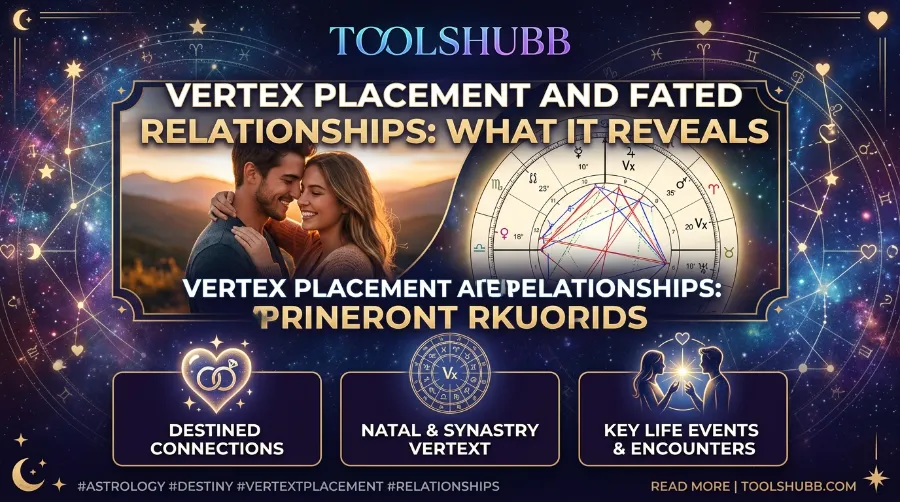
Finding your own Vertex takes only a few minutes if you already know your exact birth time.
- Gather your birth data — date, time, and city, down to the minute if possible, since the Vertex is highly time-sensitive.
- Use an extended chart calculator. On Astro.com, the Vertex appears under the Extended Chart Selection options, since most default charts hide it. Learn AstroHD
- Note the sign, house, and exact degree. Write these down before interpreting anything, so you are not tempted to guess.
- Compare it against a partner’s chart using a synastry overlay, paying closest attention to conjunctions within two to three degrees.
- Cross-check with a compatibility tool, such as our love compatibility tool, to see whether the fated pull is backed up by broader compatibility markers too.
For deeper synastry breakdowns, DeepOracle’s guide to synastry Vertex contacts and WildWitchWest’s piece on Saturn-Vertex soulmate connections both walk through additional aspect combinations worth exploring.
Common Mistakes People Make Interpreting Vertex
Even experienced chart readers slip up here, so it helps to know the traps in advance.
- Treating every Vertex hit as automatically romantic. Many Vertex contacts show up between mentors, business partners, or lifelong friends.
- Ignoring birth time accuracy. Because the Vertex shifts quickly, an inaccurate birth time can place it in the wrong sign entirely.
- Assuming fated means easy. A vertex in the 7th house often means the person is pulled into a marriage by an invisible force rather than choosing a partner through comfortable, gradual courtship, and that intensity is not always comfortable. Celesian
- Skipping the house context. The sign shows tone, but the house shows where in life the fate actually plays out, and both matter together.
If you want a lighter, numbers-based entry point before diving into full synastry, our numerology love test tool and personality number compatibility guide are both friendly starting points for readers newer to relationship astrology concepts.
Frequently Asked Questions
Is the Vertex the same as a soulmate marker?
Not exactly. It marks intensity and inevitability rather than guaranteed happiness, so treat it as one signal among several rather than final proof.
Do I need my exact birth time to find my Vertex?
Yes. Because the Vertex depends heavily on birth time and location, even a twenty-minute error can shift it into a different house.
Can the Vertex show up in friendships, not just romance?
Absolutely. These fated connections are not necessarily romantic, and can appear in relationships between siblings, mentors and students, or close friends. YourTango
What if my partner’s planet is close to my Vertex but not exact?
A wider orb, generally within three to five degrees, still counts, though the effect tends to feel softer than an exact conjunction.
Does a strong Vertex synastry connection mean the relationship will last?
Not necessarily. It signals fate and intensity, not automatic longevity, so it works best alongside broader compatibility factors like values and communication style.
Quick Vertex Knowledge Quiz
1. The Vertex is best described as:
A) A planet
B) A sensitive chart point tied to fate
C) A zodiac sign
2. The Vertex most commonly falls in which houses?
A) 1st and 2nd
B) 5th, 6th, 7th, or 8th
C) 10th and 11th
3. Which contact type feels the most fated in synastry?
A) A wide sextile
B) A tight conjunction
C) An unaspected planet
4. The anti-vertex reflects:
A) Your outer, fated world
B) Your inner private needs
C) Your career path
5. Accurate birth time matters for the Vertex because:
A) It has no real effect
B) It shifts the Vertex quickly across signs and houses
C) It only affects the Moon
Answer key: 1-B, 2-B, 3-B, 4-B, 5-B
Conclusion
Your Vertex will not run your love life for you, and it was never meant to. What it does offer is a quiet, reliable signpost pointing toward the people and moments that arrive uninvited and change everything anyway. Once you know your placement, the “random” meetings in your past often start making a lot more sense, and the ones still ahead of you become a little easier to recognize when they arrive.
References
- Cafe Astrology, The Vertex in Astrology
- Cafe Astrology, Synastry in More Detail
- Asteroid Goddesses Astrology, Vertex in Astrology: Fate and Karmic Relationships
- Mystic Bru / Return to Self, The Vertex: Your Portal to Fated Encounters
- HellaNamaste, The Destiny Point: Vertex
- Celesian, The Vertex in Astrology: Fated Encounters
- WildWitchWest, Saturn Vertex Soulmate, Karmic and Fated Relationships
- DeepOracle, Synastry Vertex Contacts
- Astrotales, Vertex in Astrology: Meaning, Fated Meetings