
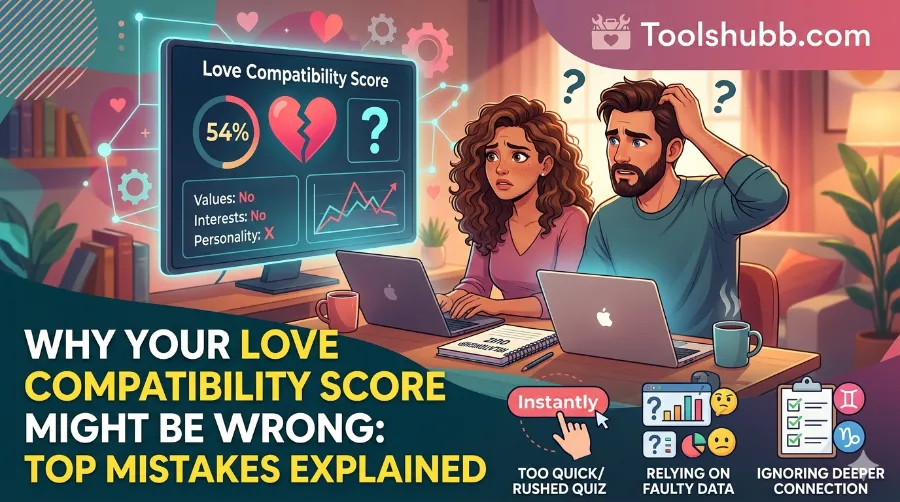

You type in two names, tap a button, and a number appears. Maybe it’s 92%. Maybe it’s 41%. Either way, your stomach reacts before your brain gets a say.
That instant emotional reaction is exactly why love compatibility calculator mistakes happen so often, and why a quick online love compatibility test can leave people feeling falsely confident or oddly heartbroken over a single afternoon. These tools are fun, fast, and free, which is great. However, the way most people use them turns a harmless bit of fun into a source of real worry. Before any score gets to decide your weekend mood, it helps to know what these calculators actually measure, and where they tend to go wrong.
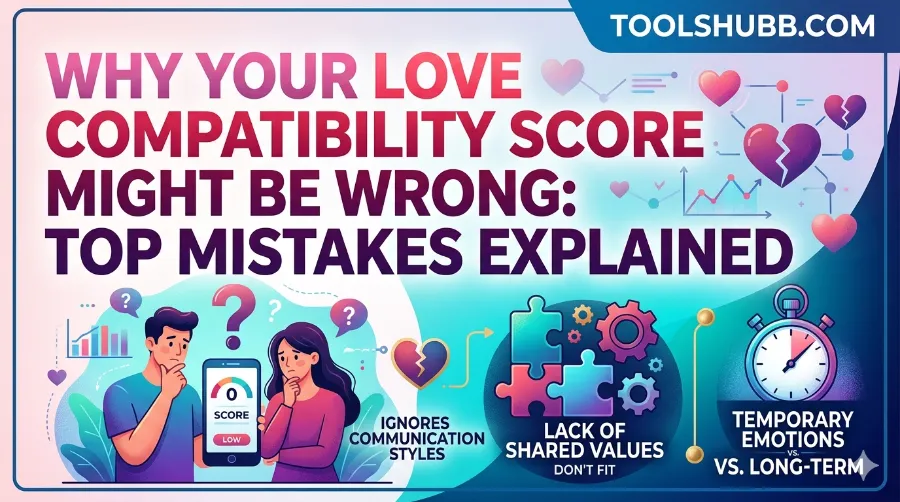
How a Love Compatibility Calculator Actually Works
Most of these tools fall into a handful of categories. A name compatibility calculator takes the letters in two names, runs them through a formula or a numerology chart, and produces a score. A zodiac love compatibility calculator, on the other hand, compares sun signs, moon signs, or full birth charts to judge how well two people might get along. Some sites blend both methods, while others add personality questions loosely inspired by psychology.
Here’s the part most people skip: none of these methods come from clinical relationship studies. In fact, Pew Research Center reported in May 2025 that around 27% of U.S. adults believe in astrology, yet only about 1% rely on it heavily when making major life decisions, according to Pew Research Center. In other words, most people already treat these scores as entertainment, which happens to be the safest way to use an online love compatibility test.
The trouble starts when that mindset slips. A bad day, a recent argument, or a nagging doubt about a partner can turn a playful percentage into “proof” of something serious. That shift is where most love compatibility test errors begin, and luckily, they are easier to avoid than most people assume.
Top Love Compatibility Calculator Mistakes That Skew Your Score
Some love percentage calculator mistakes are obvious once they’re written down. Others quietly shape how people feel about their relationships for weeks. Here are the ones that show up again and again.
Mistake 1: Treating the Score as a Final Verdict
Take Sarah, a 29-year-old teacher from Manchester who tried a zodiac love compatibility calculator with her partner in January 2025. The result came back at 38%, and within a week, she found herself picking fights over things that never used to bother her. Nothing about the relationship had changed. Only the number had.
This is the biggest reason a love percentage calculator can do more harm than good. A score reflects a formula, not feelings, effort, or shared history. When people forget that, a low result quickly becomes a self-fulfilling prophecy instead of a fun fact.
Mistake 2: Picking the Wrong Tool for the Wrong Question
In March 2025, a couple in Berlin ran their names through three different apps out of curiosity. One app returned 92%, another gave 67%, and a third landed on 45%, all for the exact same two names. None of these results were technically “wrong”; the apps simply used different formulas.
This is one of the most common relationship compatibility test mistakes: assuming every calculator measures the same thing. A name compatibility calculator and a zodiac love compatibility calculator run on completely different systems, so comparing their scores side by side rarely makes sense.
Mistake 3: Entering Inaccurate Birth Details or Name Spellings
For zodiac-based tools, even tiny input errors change the entire output. Someone born at 11:58 p.m. instead of 12:02 a.m. can end up with a different moon sign, which shifts the whole reading. Similarly, typing a nickname instead of a full legal name can change a numerology based score by several points.
Before trusting any result, it’s worth double-checking what was actually entered. A two minute correction can completely flip the outcome, which says a lot about how fragile these numbers really are.
A few more love compatibility test errors show up just as often, even among people who consider themselves skeptical:
- Comparing results across multiple apps and expecting them to match: different formulas almost always produce different numbers, so chasing a “better” score elsewhere usually backfires.
- Sharing full birth details or photos without checking the site’s privacy policy : many free calculators monetize user data, so it pays to read the fine print first.
- Letting one low score override months or years of real evidence : a percentage cannot see shared history, inside jokes, or how someone shows up during hard times.
- Ignoring communication and focusing only on the number : couples who score 95% can still struggle with conflict, while couples at 60% often thrive because they talk things through.
- Believing common love calculator myths, such as the idea that a perfect score guarantees a perfect relationship, when no online tool can measure trust, kindness, or daily effort.
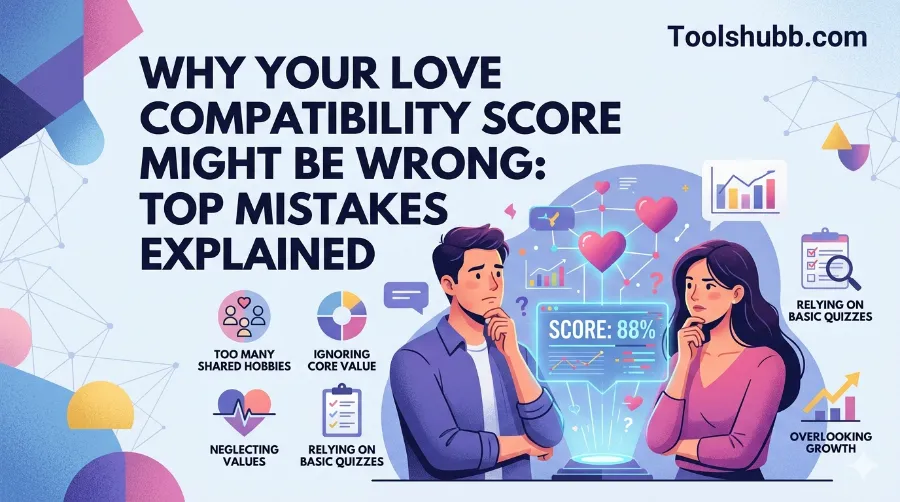
How to Use a Love Calculator Correctly
Once the common pitfalls are out of the way, these tools can actually become enjoyable again. The goal is simple: keep them in their proper place as light entertainment, not relationship therapy.
A few small habits make a big difference:
- Treat the result as a conversation starter, not a conclusion. Ask your partner what they think the score means, then turn it into a light, fun chat.
- Pick one calculator and stick with it if the numbers matter to you, so results stay consistent and comparable over time.
- Read the “how it works” page before trusting any score, since most reputable sites explain their method openly.
- Avoid checking scores during arguments or low moments, because a bad number is far more likely to feel like confirmation of doubts rather than a harmless game.
- Balance the result with real conversations about goals, habits, and values. Our relationship communication guide covers simple exercises that work better than any score.
Following these love compatibility calculator tips turns a potentially stressful exercise back into something close to its original purpose: fun.
Love Calculator Accuracy:
So, how accurate are these tools, really? Honestly, love calculator accuracy depends entirely on what it’s being measured against.
What the Research Actually Shows:
Psychologists who study relationships focus on things like shared values, communication style, and emotional responsiveness. A 2022 study published in PNAS found that early impressions of compatibility, not just attractiveness, strongly predicted later romantic interest among couples tracked over time.
according to PNAS research. Compatibility calculators, by contrast, lean on birth dates, names, or zodiac signs, none of which have been linked to relationship outcomes in large studies, as discussed by the American Psychological Association.
That gap is exactly why love compatibility calculator mistakes happen so often. People expect a scientific answer from a tool that was built for entertainment. The table below shows just how common astrology-based tools have become in the United States, even though belief in them remains a minority view.
Table 1: Astrology and Compatibility Tool Engagement in the US
| Statistic | Figure | Source |
|---|---|---|
| Adults who believe in astrology | 27% | Pew Research Center, May 2025 |
| Adults who check astrology or horoscopes at least yearly | 28% | Pew Research Center, May 2025 |
| Adults who rely heavily on astrology for major decisions | About 1% | Pew Research Center, May 2025 |
| Women aged 18–49 who believe in astrology | About 4 in 10 | Pew Research Center, May 2025 |
| Men under 50 who believe in astrology | About 2 in 10 | Pew Research Center, May 2025 |
Despite these modest belief numbers, mainstream platforms keep adding astrology and compatibility features because users simply enjoy them. In early 2026, Tinder rolled out an “Astrology Mode” that matches users based on their Sun, Moon, and Rising signs, according to Verge Magazine. This move shows how mainstream these tools have become, even without strong scientific backing.
The wider astrology and compatibility app market reflects the same trend.
Table 2: Astrology and Compatibility App Market Growth (2024–2030)
| Metric | Figure |
|---|---|
| Global market value, 2024 | Around $3 billion |
| Projected market value, 2030 | Around $9 billion |
| Annual growth rate (CAGR) | Over 20% |
| Mobile app download growth, 2022–2025 | 20–40% increase |
| Share of engagement from users aged 18–35 | About 65% |
Source: Industry market analysis, 2026
For a closer look at how zodiac signs are even calculated in the first place, our zodiac compatibility guide breaks the basics down in plain language.
Common Love Calculator Myths vs. Reality
A handful of common love calculator myths keep these misunderstandings alive. The table below breaks down a few of the most persistent ones, alongside what tends to be true in practice.
Table 3: Love Calculator Myths vs. Reality
| Myth | Reality |
|---|---|
| A 100% score means a perfect relationship | A score reflects a formula, not feelings, effort, or shared history |
| A low score means the relationship is doomed | Communication, trust, and shared goals matter far more than any number |
| Zodiac signs decide who you’ll marry | Birth charts can be entertaining, but no large study confirms predictive accuracy |
| Name calculators are based on science | Most rely on numerology, not psychology or relationship research |
| Every app should give the same result | Different formulas almost always produce different scores for the same names |
Once these myths are cleared up, it becomes much easier to enjoy a love percentage calculator without reading too much into whatever number shows up.
Frequently Asked Questions
Are love compatibility calculators accurate?
Not in a scientific sense. Most rely on birth dates, names, or zodiac signs, none of which have been shown in large studies to predict relationship success. Still, they can be genuinely fun, as long as the result isn’t treated as a verdict.
Can a love percentage calculator predict whether a relationship will last?
No single percentage can do that. Long-term relationship satisfaction depends on communication, shared values, and consistent effort, none of which a calculator can measure.
Which is more reliable: a name compatibility calculator or a zodiac love compatibility calculator?
Neither has been validated by relationship research, so “reliable” isn’t really the right word for either one. Both can be entertaining, though, especially when used together as a light, shared activity rather than a serious test.
What’s the single biggest mistake people make with these tools?
The most common issue is letting a low score affect how someone feels about a real, lived relationship. The number reflects a formula, not the people involved in it.
Is it safe to enter personal details into an online love compatibility test?
It depends on the site. Before entering full names, birth times, or locations, check the privacy policy, since some free tools collect and sell user data. Our getting started safely guide covers what to look for before sharing any details.
Conclusion
At the end of the day, a love compatibility calculator is a toy, not a verdict, and remembering that single fact prevents almost every problem on this list. Scores can spark fun conversations, surprising laughs, or even a date night idea, but they cannot replace honesty, effort, or time spent actually getting to know someone. So, the next time a number pops up on the screen, take it for what it is: a small piece of internet fun, not a forecast for your relationship. The real compatibility test happens offline, one conversation at a time.
References
- Pew Research Center. (2025, May 21). 3 in 10 Americans Consult Astrology, Tarot Cards or Fortune Tellers. https://www.pewresearch.org/religion/2025/05/21/3-in-10-americans-consult-astrology-tarot-cards-or-fortune-tellers/
- American Psychological Association. Speaking of Psychology: What Relationship Science Says About Finding Love. https://www.apa.org/news/podcasts/speaking-of-psychology/finding-love
- Baxter, A., Maxwell, J. A., Bales, K. L., Finkel, E. J., Impett, E. A., & Eastwick, P. W. (2022). Initial Impressions of Compatibility and Mate Value Predict Later Dating and Romantic Interest. PNAS. https://www.pnas.org/doi/10.1073/pnas.2206925119
- Travers, M. (2023, April 10). 24 Measures of Compatibility in Long-Term Relationships. Psychology Today. https://www.psychologytoday.com/us/blog/social-instincts/202304/24-dimensions-of-compatibility-in-long-term-couples
- Verge Magazine. (2026, March 12). Tinder Sparks 2026: How AI, Astrology, and Music Are Transforming Online Dating. https://vergemagazine.co.uk/tinder-sparks-2026-how-ai-astrology-and-music-are-transforming-online-dating/