
Have you ever typed your name and your crush’s name into a love calculator, clicked the “Calculate” button, and waited excitedly for the result? If so, you’re not alone. Millions of people around the world use love compatibility tools for entertainment, curiosity, and sometimes even reassurance about their relationships.
But one question always comes up: How accurate is a love calculator?
The short answer is that love calculators are designed primarily for fun and engagement rather than scientific relationship assessment. However, that doesn’t mean they are completely meaningless. Many people enjoy these tools because they encourage conversations about compatibility, shared interests, and the qualities that matter most in a healthy relationship.
In this article, we’ll explore how love calculators work, whether their results should be taken seriously, and why they continue to capture people’s attention in the digital age.
What Is a Love Calculator?
A love calculator is an online tool that estimates compatibility between two people based on specific inputs. These inputs can include names, birth dates, zodiac signs, or numerological information.
The goal of these calculators is simple: provide a fun way to explore romantic compatibility.
Different types of love calculators use different methods. Some rely on name-matching formulas, while others incorporate astrology or numerology concepts. Regardless of the method, the experience remains entertaining and interactive.
If you’re curious to see how these tools work firsthand, you can try Toolshubb’s Love Compatibility Tool and compare different combinations just for fun.
Why Are Love Calculators So Popular?
Love calculators have remained popular for decades, even as technology has evolved. From playground games to sophisticated online tools, people naturally enjoy discovering insights about relationships.
Several factors contribute to their popularity:
They Spark Curiosity
People are naturally curious about romance. Whether you’re in a long-term relationship or developing feelings for someone new, questions about compatibility often arise.
A love calculator provides an instant result that satisfies that curiosity.
They Create Shared Experiences
Friends often use compatibility tools together, comparing results and discussing relationships. Couples may also try them as a lighthearted activity.
As a result, these tools become social experiences rather than serious evaluations.
They Offer Entertainment
Many users understand that love calculators are designed for enjoyment. Just like personality quizzes or horoscope readings, they provide an engaging way to pass the time.
Importantly, their appeal lies in the experience itself.
How Do Love Calculators Work?
The answer depends on the type of calculator being used.
Name-Based Love Calculators
These tools analyze the letters in two names using predetermined algorithms. The algorithm generates a percentage score that represents compatibility.
For example, a calculator might assign numerical test values to letters and apply a formula to produce a final result.
It’s important to note that these calculations are not based on psychological research.
Birth Date Compatibility Tools
Some calculators incorporate birth dates into their formulas. These tools may draw inspiration from numerology concepts, which suggest that numbers hold symbolic significance.
Again, these interpretations are rooted in tradition rather than scientific consensus.
Zodiac Compatibility Calculators
Astrology based compatibility tools examine the characteristics associated with different zodiac signs.
Supporters of astrology believe that certain signs complement each other more effectively than others. Skeptics, on the other hand, view these interpretations as generalizations.
Hybrid Compatibility Tools
Modern platforms sometimes combine multiple approaches, including names, birthdays, and personality-related questions.
This creates a more interactive experience for users seeking detailed results.
Are Love Calculators Scientifically Accurate?
This is where expectations matter.
From a scientific perspective, there is currently no evidence suggesting that entering two names into a calculator can accurately predict the future of a relationship.
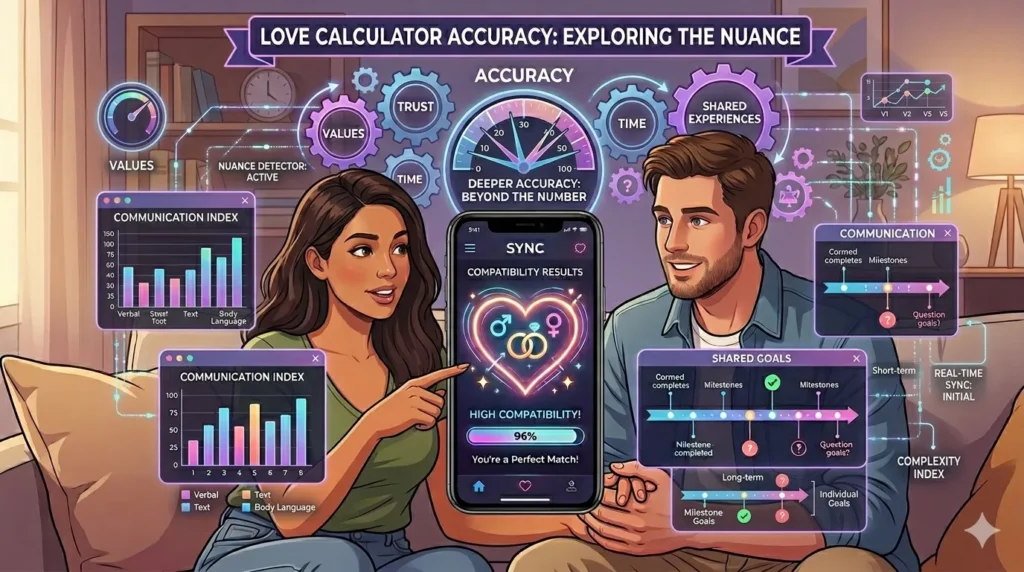
Healthy relationships are influenced by factors such as:
- Communication styles
- Shared values
- Emotional maturity
- Trust and honesty
- Conflict resolution skills
- Mutual respect
- Long-term goals
A simple algorithm cannot fully account for these complex human dynamics.
Therefore, if you’re asking whether a love calculator can definitively determine whether two people are destined to stay together forever, the answer is no.
However, that doesn’t mean these tools have no value.
Can Love Calculators Still Be Meaningful?
Surprisingly, yes depending on how you use them.
Many people approach compatibility tools with a playful mindset. Rather than treating the results as facts, they use them as conversation starters.
For example, receiving a low compatibility score might encourage couples to discuss what truly matters in their relationship.
Similarly, a high score can prompt conversations about shared interests and future goals.
The key is maintaining realistic expectations.
Love calculators should complement real-world communication, not replace it.
What Relationship Experts Say About Compatibility
Relationship experts generally agree that successful partnerships depend on behaviors rather than predictions.
Strong relationships often involve:
- Active listening
- Consistent effort
- Emotional support
- Healthy boundaries
- Willingness to grow together
No online tool can measure these qualities perfectly.
As a result, compatibility assessments are best viewed as sources of entertainment rather than relationship advice.
Nevertheless, many couples enjoy these experiences because they add an element of fun to discussions about love and connection.
Why People Continue Using Love Calculators
Even though most users understand their limitations, love calculators continue to attract millions of visitors every year.
The reasons are simple.
They are:
- Easy to use
- Instantly rewarding
- Fun to share
- Free to access
- Emotionally engaging
In today’s fast-paced world, people appreciate experiences that provide moments of excitement and curiosity.
Love calculators fulfill that role remarkably well.
Should You Trust Love Calculator Results?
The healthiest approach is balance.
Enjoy the experience, laugh at surprising outcomes, and use the results as opportunities for reflection.
At the same time, avoid making major relationship decisions based solely on a compatibility percentage.
Real relationships are built through understanding, patience, and mutual commitment.
A calculator may generate a number, but the quality of a relationship depends on the choices people make every day.
Benefits and Limitations of Love Calculators
Love calculators can be fun, but understanding their strengths and limitations helps you use them in a healthy way.
Benefits of Using Love Calculators
1. They Encourage Conversation
Many couples struggle to start meaningful discussions about relationships. Surprisingly, a simple compatibility test can become an icebreaker.
For example, a couple who receives a low compatibility score might ask:
- What do we value most in our relationship?
- How do we handle disagreements?
- What are our future goals?
These conversations often provide more insight than the score itself.
2. They Add Fun to Relationships
Relationships should include moments of laughter and playfulness. Many people use love calculators simply because they enjoy comparing results with partners or friends.
Sometimes, the excitement of seeing a percentage score creates memorable experiences.
3. They Reflect Human Curiosity
Humans have always searched for ways to understand love. From ancient matchmaking traditions to modern dating apps, people naturally seek reassurance and guidance.
Love calculators are simply a digital version of that timeless curiosity.
The Limitations You Should Know
Despite their popularity, love calculators cannot measure the factors that truly influence relationship success.
They Cannot Predict the Future
A compatibility score cannot determine whether a couple will stay together.
Relationships evolve over time. People grow, priorities change, and challenges arise.
No algorithm can accurately forecast how two individuals will navigate life’s complexities together.
They Don’t Measure Emotional Intelligence
Successful relationships often depend on qualities such as:
- Empathy
- Patience
- Commitment
- Respect
- Accountability
- Effective communication
These characteristics develop through real-life experiences and cannot be captured by a name-based formula.
Results Should Never Guide Major Decisions
A low score doesn’t mean you should end a healthy relationship.
Likewise, a high score doesn’t guarantee lifelong happiness.
Major relationship decisions deserve thoughtful consideration rather than reliance on entertainment tools.
Real Relationship Facts: What Research Shows
While love calculators provide enjoyment, relationship science highlights different predictors of long-term success.
Fact #1: Communication Matters More Than Compatibility Scores
Relationship researchers have consistently found that how couples handle conflict often matters more than how similar they are.
Healthy couples aren’t necessarily those who never argue.
Instead, they tend to resolve disagreements respectfully and repair emotional connections after conflict.
Fact #2: Technology Plays a Bigger Role in Modern Relationships
Recent surveys show that approximately three in ten American adults have used dating platforms at some point in their lives.
This demonstrates how comfortable people have become with digital tools in the search for connection.
However, digital experiences still cannot replace genuine human interaction.
Fact #3: Shared Values Often Predict Stability
Many relationship counselors emphasize the importance of discussing topics such as:
- Financial expectations
- Family planning
- Religious beliefs
- Career goals
- Lifestyle preferences
Alignment in these areas frequently contributes to stronger partnerships.
Love Calculator vs Real-Life Compatibility
Think of a love calculator as the trailer, not the entire movie.
It offers a glimpse into a playful possibility.
Real compatibility, however, develops through shared experiences.
Consider these scenarios:
Scenario One
Emma and Noah receive a compatibility score of 42%.
They communicate openly, support each other’s ambitions, and work through disagreements respectfully.
Their relationship thrives.
Scenario Two
Sophia and Liam receive a score of 96%.
However, they struggle with trust issues and avoid difficult conversations.
Over time, unresolved conflicts weaken their bond.
These examples highlight an important truth:
The quality of a relationship depends more on daily actions than digital percentages.
When Should You Use a Love Calculator?
Love calculators can be enjoyable when used appropriately.
You might use one when:
- Spending time with friends.
- Exploring a new crush in a lighthearted way.
- Looking for entertainment online.
- Starting conversations about compatibility.
- Celebrating anniversaries with your partner.
The experience becomes most valuable when approached with curiosity rather than certainty.
Try Toolshubb’s Love Compatibility Tool
If you’re curious about your own compatibility score, you can explore Toolshubb’s Love Compatibility Tool.
Use it as an entertaining activity and an opportunity to discuss what truly matters in relationships.
Remember, the result is only the beginning of the conversation.
The real story is written through trust, understanding, kindness, and consistent effort.
Frequently Asked Questions
How accurate is a love calculator?
Love calculators are primarily designed for entertainment purposes. They cannot scientifically predict relationship outcomes.
Should I trust love calculator results?
Enjoy them for fun, but avoid making important relationship decisions based solely on compatibility percentages.
Can a love calculator predict marriage success?
No. Long-term relationship success depends on communication, shared values, commitment, and emotional support.
Why do people use love calculators?
People use them because they’re entertaining, easy to access, and often spark meaningful conversations about relationships.
Is a low compatibility score a bad sign?
Not necessarily. Healthy relationships are built through effort and understanding rather than algorithmic predictions.
Conclusion
So, how accurate is a love calculator?
If you’re looking for scientific certainty, the answer is simple: these tools cannot predict the future of your relationship.
However, if you’re looking for a fun experience that encourages reflection and conversation, love calculators continue to serve that purpose remarkably well.
At their best, they remind us of something important:
Love isn’t determined by a percentage.
It’s shaped by the choices we make, the respect we show, and the effort we invest in the people who matter most.