
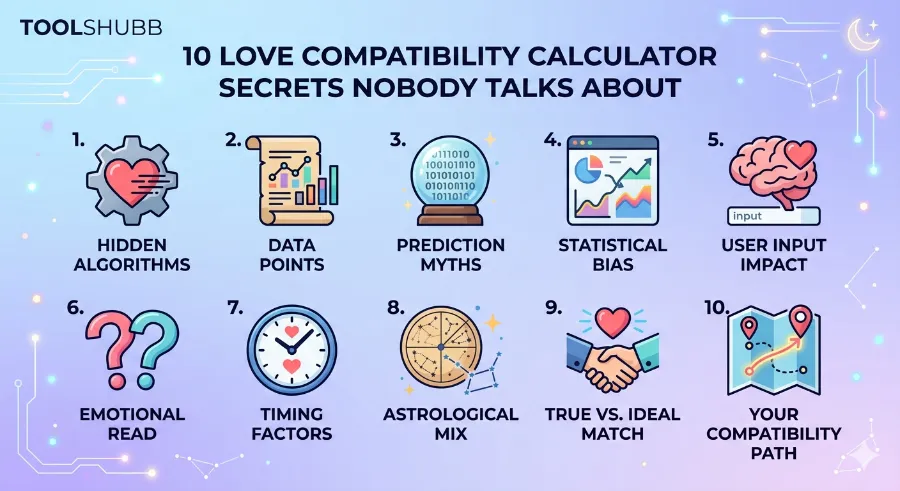

You type in two names. You hit “calculate.” A number pops up, and somehow it feels like it knows something about you. Love compatibility calculators have quietly become one of the internet’s favorite pastimes, especially among people in the United States and across Europe who are curious about their love life. But before you trust that percentage, there are a few things worth knowing.
In this guide, we will walk through ten secrets about how these tools actually work. We will also look at real research, share examples, and compare what calculators say versus what relationship scientists have found. By the end, you will know exactly how much weight to give that score.
How Love Compatibility Calculators Actually Work
Most people assume there is some hidden science behind these tools. However, the reality is much simpler than that. Most calculators rely on basic numerology, where each letter in your name is given a number value.
These numbers are then added, averaged, or run through a formula. As a result, you get a percentage between 0 and 100. Some tools also factor in birthdates or zodiac signs to add another layer of “personalization.”
For example, one popular calculator openly states it uses an algorithm based on names, letters, and numerology patterns, designed strictly for entertainment. So while the output looks scientific, the input is largely cosmetic. Calci
You can also check our Dating Tips Generator Tool for more fun
Secret 1: The Score Is Often Decided Before You Even Click
Because the formula uses your name and your partner’s name, the result is essentially fixed the moment you type those names in. Therefore, no matter how many times you click “calculate,” you will get the same number.
Some calculators even admit this directly. One tool describes itself as generating a deterministic score using a tiny name-based sprinkle, while reminding users that real relationships are about growth, respect, and effort. Calci
Secret 2: Most Scores Avoid the Extremes
Have you ever gotten a 3% or a 99%? Probably not often. Most calculators are designed so scores cluster somewhere in the middle to upper range, because extreme numbers feel less believable and less fun to share.
Interestingly, real user comments support this pattern. On one well-known love calculator, visitors reported scores like 97.08%, 89%, and 87% for different couples, while another user got a 12%. Notice how the high scores dominate the feedback, which keeps people coming back for more. RogerHub
Secret 3: Reordering Names Can Change Your Score
Here is a fun experiment. Type “Alex and Maria,” note the score, then type “Maria and Alex.” On many calculators, the result will shift slightly.
This happens because of how the algorithm processes the string of letters in sequence. Consequently, the order of input becomes part of the math, even though it has zero connection to real compatibility.
Why a Relationship Compatibility Test Feels So Accurate
This is where psychology enters the picture. When a calculator says something like “you communicate well, but you sometimes hold back your feelings,” it feels personal. However, that description applies to almost everyone.
This effect, often called the Barnum effect, is the same reason horoscopes feel accurate. Vague, broadly true statements get matched to our own experiences, so we fill in the blanks ourselves.
Secret 4: The “Story Behind the Score” Trick
Many modern calculators do not just give you a number. They also give you a story, comparing your relationship to famous couples or characters. For instance, one tool tells users that a score between 75 and 100 percent resembles a bond like Naruto and Hinata’s, while scores between 60 and 75 percent feel more like Monica and Chandler’s relationship from Friends. ProKerala
This storytelling layer makes the result feel richer and more shareable. As a result, people post their scores on social media, which helps these tools spread organically.
Secret 5: A Lot of “Free” Calculators Want Your Data
Some calculators ask for more than just two names. They might request your email, birthdate, or even social media login before showing your “deeper” results.
Here is a quick checklist to protect yourself:
- Avoid entering your full real name and exact birthdate together.
- Skip calculators that require an email signup for a “fun” result.
- Never link social accounts just to see a compatibility score.
- Check if the site has a clear privacy policy before continuing.
If a site cannot answer where your data goes, that is a red flag, regardless of how fun the quiz looks.
Love Calculator Accuracy: What the Research Actually Shows
This is the part most blog posts skip. So, what does real research say about predicting relationship success?
A 2025 case study surveying 1,000 participants aged 16 to 35 across five countries found that 78 percent of respondents used love calculators “just for fun” or out of curiosity, while 41 percent admitted they “partially believe” the results. In other words, even users themselves do not fully trust these tools, yet they still enjoy them. Medium
Meanwhile, actual relationship science tells a very different story. According to research from the Gottman Institute, which studied more than 3,000 couples over four decades, divorce can be predicted with around 94 percent accuracy by observing communication patterns like criticism, contempt, defensiveness, and stonewalling. Yung-sidekick
That is a massive difference. A name-based calculator has zero scientific validation. A communication-pattern study, on the other hand, has decades of longitudinal data behind it.
Secret 6: It’s About Communication, Not Compatibility
Here is something that might surprise you. The Gottman Institute’s findings suggest that how couples talk to each other, not their shared interests or income, is the strongest predictor of whether a relationship survives. Connectedcouples
This means two people with a “low” calculator score could have a thriving relationship if they communicate well. Conversely, a “99% match” couple could still struggle if they fall into negative communication habits.
Secret 7: Stable Couples Follow a Specific Ratio
Real research has identified actual numerical patterns in successful relationships, unlike calculator percentages. For example, stable marriages tend to have about five positive interactions for every one negative interaction during conflict, while happy couples maintain a ratio closer to 20 positive interactions to 1 negative during everyday life. Flourishing-lives
Compare that to a calculator’s single percentage, which cannot measure interaction patterns at all. The contrast really highlights how different these two worlds are.
Secret 8: Divorce Rates Are Actually Falling
Many people assume half of all marriages fail, and calculators often play into this fear by promising to help you “avoid a bad match.” However, current data tells a more hopeful story.
In fact, the U.S. crude divorce rate dropped to roughly 2.4 divorces per 1,000 people in 2022, down from 4.0 per 1,000 in 2000 and a peak of 5.3 per 1,000 in 1981. So while a calculator might warn you about “risk,” the bigger picture shows couples today are doing better than previous generations. Connectedcouples
Comparing Calculator Claims vs. Real Relationship Research
| Factor | Love Compatibility Calculator | Relationship Science (Gottman Research) |
|---|---|---|
| Input used | Names, birthdates, zodiac signs | Real-time conversation patterns |
| Sample size | Often none, or unclear | Over 40,000 couples studied |
| Accuracy claim | Unverified, entertainment only | Around 94% for divorce prediction |
| Result type | Single percentage | Behavioral patterns and ratios |
| Can it change? | No, fixed by input | Yes, communication skills can be learned |
This table makes the difference pretty clear. One side is designed for fun, while the other is built on decades of observation.
Secret 9: Zodiac Calculators Have Their Own Hidden Bias
A name compatibility calculator is one thing, but a zodiac compatibility calculator adds another layer. These tools often highlight only the positive traits that two signs share, while quietly downplaying known friction points between certain signs.
For more on how astrology-based matching works, you can check our related guide at /zodiac-compatibility-guide. It breaks down which sign pairings get the rosiest treatment and why.
Secret 10: The Real Value Is the Conversation It Starts
Here is perhaps the most overlooked secret of all. Even though the score itself means nothing scientifically, the conversation it sparks can mean a lot.
When couples laugh about a low score or celebrate a high one, they are bonding. So in a strange way, the calculator’s real value is not the math, it is the moment of connection it creates.
If you want tips on turning these moments into deeper conversations, our guide at /relationship-communication-tips offers practical exercises based on real therapy techniques.
How Love Calculators Compare Across Different Types
Below is a simple breakdown of the most common types of compatibility tools and what they actually measure.
| Calculator Type | What It Uses | What It Claims to Show |
|---|---|---|
| Name compatibility calculator | Letters in both names | A “match percentage” |
| Zodiac compatibility calculator | Birth dates and star signs | Personality alignment |
| Numerology-based calculator | Birthdates converted to numbers | Life path compatibility |
| Quiz-based love test | Multiple choice answers | Relationship style match |
As you can see, none of these directly measure communication, trust-building, or conflict resolution, which research shows actually matter most.
Frequently Asked Questions
Are love compatibility calculators ever accurate?
Not in a scientific sense. They can occasionally feel accurate because of vague, broadly applicable descriptions, a psychological effect known as the Barnum effect.
Do calculators use real data about me?
Usually not beyond the name or birthdate you enter. However, some sites collect this data for marketing purposes, so it pays to check the privacy policy first.
What actually predicts relationship success?
According to long-term studies, communication patterns, conflict resolution skills, and the ratio of positive to negative interactions matter far more than any name-based score.
Should couples avoid using these calculators?
Not necessarily. They can be a fun activity, similar to a horoscope, as long as nobody treats the result as a serious verdict on their relationship. For more ideas on healthy relationship habits, see /healthy-relationship-habits.
Why do scores rarely go below 40%?
Many calculators are designed to keep results within a comfortable, shareable range, since extremely low scores feel less believable and are less likely to be shared.
Conclusion
Love compatibility calculators are entertaining, and there is nothing wrong with trying one out for fun. However, as we have seen, the math behind them has little to do with real compatibility. Meanwhile, decades of relationship research point to communication patterns, not name letters, as the true predictor of lasting love. So go ahead and enjoy your next compatibility quiz, but remember that the real work of love happens in conversations, not calculations.
References
- The Gottman Institute, Research on Marriage and Couples: https://www.gottman.com/about/research/couples/
- Connected Couples, Relationship Statistics 2026: https://www.connectedcouples.app/blog/relationship-statistics