

Silence can feel louder than shouting. If you have ever watched your partner change the subject, leave the room, or shut down the moment things get emotional, you already know that feeling. You are not imagining it, and you are definitely not alone. Learning to handle a partner who avoids difficult conversations is one of the most common struggles couples face, and thankfully, it is also one of the most solvable.
This guide walks you through why avoidance happens, what it looks like in real relationships, and exactly how to gently open the door to honest talks again. Whether you are dealing with a conflict avoidant partner who shuts down during arguments or simply trying to get a partner to open up, these tips are grounded in real psychology and real results.
Here is our detailed information about Relationship Advice for Couples Dealing With Chronic Illness read our latest blog
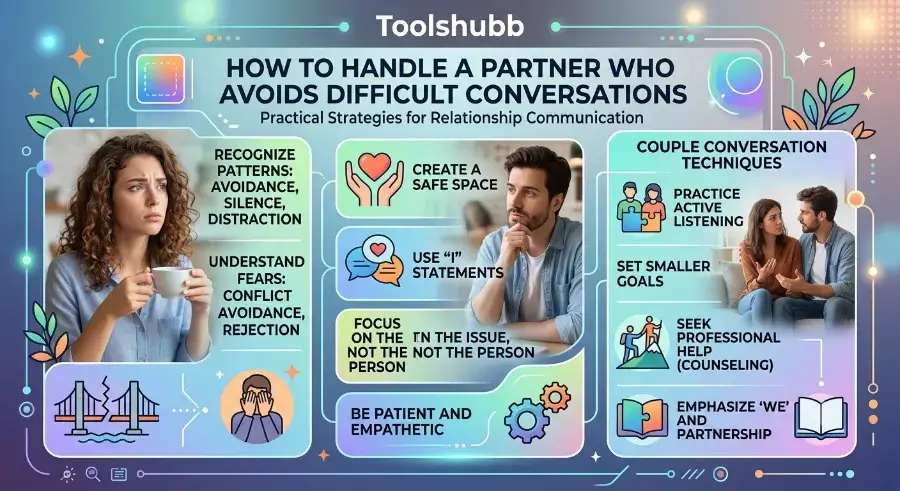
Key Takeaways
| Topic | Quick Insight |
|---|---|
| Why avoidance happens | Often linked to childhood experiences, past hurt, or attachment style, not a lack of love |
| Most common pattern | The demand-withdraw cycle, where one partner pushes and the other pulls away |
| Best first step | Create emotional safety before starting the hard talk, not during it |
| Timing matters | Avoid bringing up serious issues right before bed, during meals, or in public |
| Long-term fix | Small, low-pressure conversations build trust faster than one big confrontation |
| Related reads | See our guides on navigating financial disagreements and different career ambitions |
Why Some Partners Avoid Difficult Conversations
Before you can fix a pattern, you need to understand where it comes from. Most people who dodge hard talks are not doing it out of spite. Instead, they are often protecting themselves from feelings that once felt unsafe.
It Usually Starts Long Before You Met
A 2022 dyadic study published in Frontiers in Psychology followed 175 heterosexual couples between the ages of 18 and 72 and found that avoidant attachment was linked to a withdrawal pattern during conflict, which in turn affected relationship satisfaction for both partners. In simple terms, someone who learned early on that expressing needs led to disappointment often grows into an adult who pulls back the moment things get tense. frontiersinfrontiersin
This is not a character flaw. It is a learned survival strategy, and it can be unlearned with patience and the right approach.
The Demand-Withdraw Cycle
Therapists often describe this pattern as demand and withdraw. One partner raises a concern, and the other partner retreats. The more the first partner pushes, the more the second one pulls away, and the cycle repeats until both people feel exhausted and unheard.
Recent research backs this up clearly. A 2025 study of 133 young couples with an average age of 19.44 years found that romantic attachment styles played a meaningful role in how couples managed conflict and influence within the relationship. Even in younger relationships, these patterns show up early and tend to repeat unless someone breaks the loop. Wiley Online Library
Signs You Are Dealing With a Conflict Avoidant Partner
Recognizing the pattern is the first step toward change. Here are common signs to watch for:
- They physically leave the room or go quiet mid-conversation
- They agree quickly just to end the discussion, then nothing actually changes
- They bring up unrelated topics or humor to defuse tension
- They say “I’m fine” repeatedly, even when their body language says otherwise
- They avoid future plans that require discussing feelings, finances, or commitment
If several of these sound familiar, you are likely dealing with a conflict avoidant partner, and the good news is that this pattern responds well to a calmer, more strategic approach.
The Emotional Cost of Constant Avoidance
Avoidance rarely stays contained to one topic. Over time, unresolved issues pile up, and small resentments quietly become bigger ones. Partners who consistently avoid conflict tend to score lower on relationship satisfaction, according to attachment researchers, because unspoken needs simply do not disappear on their own.
Meanwhile, the partner who wants to talk often starts to feel invisible. This is exhausting, and it can lead to a painful cycle where one person feels unheard while the other feels cornered. Breaking this cycle requires a shift in strategy, not just more effort.
How to Handle a Partner Who Avoids Difficult Conversations
Now for the part you actually came here for. Below are practical, therapist-backed strategies that genuinely help.
1. Choose the Right Moment, Not the Convenient One
Timing changes everything. Bringing up a serious topic right after work, during a meal, or in front of others almost guarantees a shutdown. Instead, ask for a specific time to talk, and let your partner know the general topic in advance.
For example, instead of saying “we need to talk” out of nowhere, try: “I’d like to talk about how we handle money stress sometime this weekend, no rush.” This small shift removes the ambush feeling that triggers avoidance in the first place.
2. Lead With Curiosity Instead of Accusation
Words like “you always” or “you never” instantly put people on the defensive. Swapping accusatory language for curious language keeps the door open. Try phrases like “I noticed” or “I’m wondering if” instead of blunt accusations.
This single change in tone often determines whether a conversation opens up or shuts down within the first thirty seconds. As experts at the Attachment Project explain, approaching an avoidant partner with patience and softened language rather than pressure tends to produce far better results than direct confrontation.
3. Create Emotional Safety First
Before diving into the issue itself, remind your partner that the goal is connection, not punishment. A simple line like “I’m not trying to fight, I just want us to understand each other better” can lower defenses significantly.
Safety is the foundation every difficult conversation needs. Without it, even the gentlest words will feel threatening to someone wired to expect conflict as danger.
4. Use the Pause, Don’t Force the Push
If your partner needs a moment to process, let them have it. Forcing an immediate response usually backfires and pushes conflict avoidant partners further into their shell.
Instead, agree on a signal, such as “let’s take twenty minutes and come back to this,” so the conversation pauses without disappearing entirely. This respects their processing style while keeping the topic alive.
5. Keep Conversations Short and Frequent
Big, all-at-once conversations overwhelm avoidant partners. Smaller, more frequent check-ins tend to work far better than one dramatic sit-down talk.
Consider these simple structures:
- A five-minute daily check-in about how the day went emotionally
- A weekly “state of the relationship” conversation with no distractions
- Monthly deeper talks about bigger topics like finances or future goals
This gradual approach builds a habit of openness rather than treating vulnerability like a rare, high-stakes event.
Getting a Partner to Open Up: Long-Term Strategies
Handling one hard conversation is helpful, but the real goal is building a relationship where opening up feels normal. Below are strategies for the long game.
Model Vulnerability Yourself
People often open up when they feel it is safe, and safety is contagious. When you share your own feelings calmly and without blame, it signals that vulnerability will not be punished here.
Try sharing something small and low-stakes first, such as a work worry or a minor insecurity. Once your partner sees that sharing does not lead to judgement, bigger topics tend to follow more naturally.
Avoid Turning Every Talk Into a Debate
Some partners avoid conversations because every past discussion turned into a fight to win rather than a problem to solve together. Shifting the goal from “winning” to “understanding” removes a major source of dread.
According to relationship coach Stephanie Rigg, supporting an avoidant partner effectively often means slowing down and prioritizing connection over being right, which naturally lowers the emotional stakes of each conversation.
Recognize When Professional Support Helps
Sometimes avoidance is rooted deeper than daily habits, tied instead to past trauma, family patterns, or long-held fears around conflict. In these cases, a couples therapist can offer tools that go beyond what either partner can manage alone.
There is no shame in this step. In fact, seeking support early often prevents years of built-up frustration, similar to how couples working through career ambition differences often benefit from outside guidance when the gap feels too wide to bridge alone.
What Not to Do When Your Partner Shuts Down
Just as important as knowing what helps is knowing what to avoid. Here are common mistakes that make avoidance worse:
- Chasing them when they walk away, which increases pressure and panic
- Bringing up multiple issues at once instead of one topic at a time
- Using ultimatums as a way to force engagement
- Comparing them to an ex or another couple
- Publicly discussing private struggles, which damages trust further
Avoiding these traps protects the fragile progress you are trying to build.
Real Example: How Timing Changed Everything
Consider a common scenario. A couple married for six years struggled for months because every attempt to discuss shared finances ended in silence or a slammed door. After shifting their approach in early 2025, scheduling a specific fifteen-minute weekly “money check-in” instead of ambushing each other mid-week, they reported noticeably calmer conversations within about six weeks.
This mirrors advice found in guides on handling financial disagreements, where structure and predictability consistently reduce defensiveness far more than spontaneous confrontation ever does.
A Closer Look at Conflict Patterns
Below is a simple comparison chart you can copy directly into your post to illustrate common conflict styles and outcomes.
| Conflict Style | Common Behavior | Typical Outcome | Better Alternative |
|---|---|---|---|
| Demand-Withdraw | One pushes, one pulls away | Resentment builds over time | Scheduled, low-pressure check-ins |
| Avoidant Shutdown | Silence, leaving, changing topics | Issues remain unresolved | Pause and return agreements |
| Explosive Confrontation | Sudden intense arguments | Emotional exhaustion | Curious, calm opening lines |
| Secure Communication | Open, steady dialogue | Higher satisfaction over time | Continued small vulnerability |
Feel free to paste this table straight into your Elementor text widget as a visual reference for readers.
When Avoidance Signals Something Deeper
Occasionally, avoidance is not just a communication style but a symptom of burnout within the relationship itself. If both partners feel drained and disconnected, it may be worth exploring whether relationship fatigue is playing a role.
Our detailed guide on avoiding relationship burnout covers this connection in depth and offers additional tools for couples feeling stretched thin. Recognizing burnout early often prevents avoidance from hardening into permanent distance.
Frequently Asked Questions
Why does my partner avoid conflict instead of talking things through?
Most people who avoid conflict learned early in life that expressing needs led to disappointment or punishment, so silence became a safer option than speaking up.
Can a conflict avoidant partner change over time?
Yes, with consistent patience, safety, and small low-pressure conversations, many avoidant partners gradually become more comfortable opening up.
Is it my fault if my partner shuts down during arguments?
Not necessarily. Shutting down is usually a self-protective habit built long before your relationship began, though tone and timing can still influence how often it happens.
How long does it take to get a partner to open up more?
There is no fixed timeline, but many couples notice small improvements within a few weeks of consistent, gentle effort and scheduled check-ins.
Should we see a therapist if avoidance keeps happening?
If avoidance continues despite genuine effort from both sides, a couples therapist can offer structured tools that speed up progress significantly.
Quick Relationship Quiz: How Well Do You Handle Avoidance?
Test your instincts with this quick five-question quiz.
- Your partner goes quiet during an argument. What is the best first move?
A) Keep talking louder to get a response
B) Give them a short pause and revisit calmly later
C) Walk away and ignore the topic forever - Which phrase is more likely to open a conversation instead of closing it?
A) “You never listen to me”
B) “I noticed we haven’t talked about this, can we?”
C) “We need to talk right now” - What is a healthy long-term habit for avoidant partners?
A) Occasional big, emotional confrontations
B) Small, frequent check-ins
C) Avoiding the topic until it resolves itself - What often triggers shutdown behavior the most?
A) Feeling ambushed or blamed suddenly
B) Being asked simple daily questions
C) Spending quiet time together - When should you consider outside help like therapy?
A) Only after years of silence
B) When avoidance continues despite genuine effort
C) Never, since couples should solve everything alone
Answer Key: 1-B, 2-B, 3-B, 4-A, 5-B
Curious to see where you stand? ToolsHubb gives you several free ways to check compatibility and get personalized insights. Start with the Love Compatibility Tool for a quick, instant score, or dig deeper with the Numerology Love Test based on your birth date. If you’re more drawn to astrology, the Zodiac Compatibility Calculator and the Chinese Zodiac Compatibility Tool both reveal how your signs align with a partner’s. For guidance tailored to your specific situation, try the Relationship Advice Generator, and if you’re getting back into the dating scene, the Dating Tips Generator can help you approach it with more confidence.
Conclusion
Handling a partner who avoids difficult conversations takes patience, but it is far from impossible. Once you understand that avoidance usually comes from old protective habits rather than a lack of love, everything starts to make more sense. With the right timing, softer language, and small consistent steps, most couples can rebuild the kind of openness that makes hard conversations feel safe again. Progress may be slow at first, yet every small win adds up to a stronger, more honest connection over time.
References
- Bretaña, I., Alonso-Arbiol, I., Recio, P., & Molero, F. (2022). Avoidant Attachment, Withdrawal-Aggression Conflict Pattern, and Relationship Satisfaction. Frontiers in Psychology.
- Vicario-Molina, I., Fernández-Fuertes, A. A., Fuertes, A., & Orgaz-Baz, M. B. (2025). Attachment, Power/Influence, Conflict Management Strategies. Scandinavian Journal of Psychology.
- Rigg, S. 5 Ways to Support an Avoidant Partner
- Rossler, K. How to Handle a Conflict Avoidant Partner
- The Attachment Project. How to Communicate With an Avoidant Partner