
Picture this: it’s a quiet Tuesday night, and instead of scrolling through random videos, you and your partner are debating whether your star signs actually get along. That small, silly argument is exactly why a love compatibility calculator has become such a popular icebreaker for couples across the US and Europe. These quick online quizzes promise insight into how well two people click, and millions of people try one out of pure curiosity. However, with zodiac, numerology, name based, and personality versions all competing for attention, picking the right tool can feel overwhelming. This guide breaks each type down in plain language so you can choose one that actually matches how you and your partner connect.
What Exactly Do These Compatibility Tools Measure?
At a basic level, a compatibility tool collects a few personal details birth dates, full names, or quiz answers and runs them through a formula or scoring system. The result usually appears as a percentage score or a short written summary of your strengths as a couple. For many people, this works as a simple love compatibility test for couples who just want a lighthearted way to spark conversation on date night.
Other versions go deeper. They ask dozens of questions about communication habits, financial values, and daily routines before generating a report. Neither approach is “wrong.” They simply serve different purposes, and knowing the difference helps you set the right expectations. You can try a beginner-friendly version on our free compatibility calculator to see how the process works.
Why Couples Run a Relationship Compatibility Test Before Getting Serious
Online dating has changed how people meet, and compatibility scoring is now baked into that experience. Pew Research Center reports that roughly 30% of US adults have used a dating site or app at some point, with usage climbing to 53% among adults aged 18 to 29. Many of these platforms already nudge users toward some form of matching score before a first message is even sent.
Because of this shift, a relationship compatibility test no longer feels like a novelty. Instead, it has become a normal part of getting to know someone, similar to checking a restaurant review before booking a table. That said, the appeal goes beyond convenience. For long-distance couples or those still in the early stages, a quick quiz offers a low-pressure way to open up topics that might otherwise feel awkward to bring up directly.
The Science (and the Limits) Behind the Score
It is worth being honest here: most calculators are built for entertainment, not clinical accuracy. Dr. John Gottman, a researcher who has studied thousands of couples through The Gottman Institute, has pointed out that matching personality traits is not actually a strong predictor of relationship success. What matters far more, according to his decades of observational research, is how two people handle conflict and repair disagreements after they happen.
This does not mean compatibility tools are useless. Rather, it means the score itself should be treated as a conversation starter rather than a verdict. A high percentage might make you smile, while a lower one might prompt a useful chat about expectations.
6 Types of Love Calculators, Explained
Not all calculators work the same way. Some lean on astrology, others on math, and a few try to borrow ideas from real psychology research. Here is a quick breakdown of the most common formats you will come across.
Zodiac Compatibility Calculator
A zodiac compatibility calculator compares the sun signs (and sometimes moon or rising signs) of two people based on their birth dates. It then scores the pairing using traditional astrology rules about which elements, such as fire or water signs, tend to blend well together.
Astrology has surged in popularity recently, especially among younger adults. A September 2024 survey by EduBirdie found that 80% of Gen Z and millennial respondents said they believe in astrology at least some of the time, and more than two-thirds admitted to checking a potential partner’s zodiac sign before dating them. About one in three said they would hesitate to date someone with a sign they consider incompatible.
Name Compatibility Calculator
A name compatibility calculator assigns numeric values to the letters in two names, then adds them up to produce a score. For example, entering “Alex” and “Jordan” into a typical tool might return something like 78%, based purely on a letter-value formula rather than any psychological assessment.
This format is popular at parties, on wedding invitation websites, and even printed on novelty mugs. It carries no scientific weight, but it remains a fun, low-stakes way to spark a laugh between partners.
Personality-Based Couples Compatibility Quiz
This version borrows ideas from established frameworks like the Big Five personality traits or Myers Briggs typing. A couples compatibility quiz built this way usually asks each partner to answer 20 to 40 questions about habits, values, and emotional tendencies before comparing the results side by side.
Because it draws on real personality research, this format tends to feel more substantial than a zodiac or name-based score. Still, personality alignment alone does not guarantee a smooth relationship, especially since opposites often balance each other out in healthy ways too.
Numerology Life Path Calculator
This tool calculates a “life path number” from each partner’s full birth date, then compares the two numbers using numerology charts. Believers see it as a window into shared purpose, while skeptics view it purely as entertainment.
Love Language Quiz
Based loosely on Gary Chapman’s well-known framework, this quiz identifies how each partner prefers to give and receive affection through words, gifts, touch, acts of service, or quality time. Couples often find this version genuinely useful because it leads to practical, actionable conversations.
AI Matching Calculator
Newer tools use AI driven algorithms that analyze quiz answers, behavior patterns, or even messaging style to estimate compatibility. Several major dating apps had already rolled out predictive matching features by 2024, aiming to suggest pairings before users even start swiping.
| Calculator Type | What It Uses | Best For | Research Backing |
|---|---|---|---|
| Zodiac Compatibility Calculator | Birth dates, astrology charts | Fun first dates | None (entertainment) |
| Name Compatibility Calculator | Letters in full names | Parties, icebreakers | None (entertainment) |
| Personality Quiz | Big Five / MBTI-style answers | Established couples | Moderate |
| Numerology Calculator | Birth date life-path numbers | Curious beginners | None (entertainment) |
| Love Language Quiz | Self-reported preferences | Improving daily connection | Moderate to strong |
| AI-Matching Calculator | Behavior and answer patterns | Online daters | Growing, app-dependent |
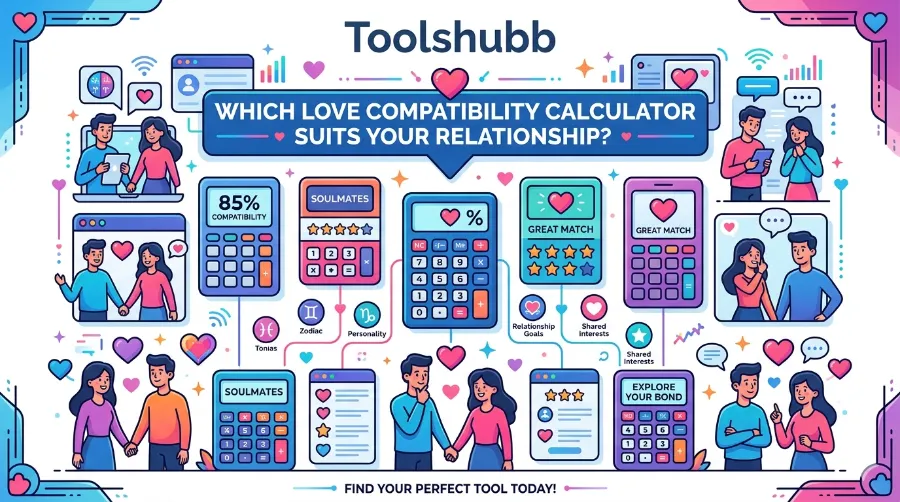
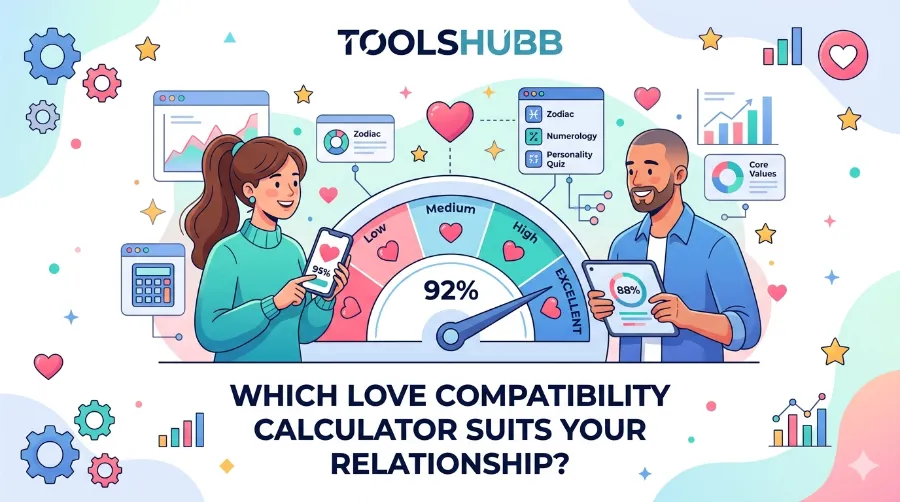
Which Love Compatibility Calculator Suits Your Relationship?
Choosing the right format mostly comes down to what you actually want from the experience. Use the steps below to narrow things down quickly.
- Decide if you want fun or insight. If you are looking for a laugh on a first date, a zodiac compatibility calculator or name based tool works well. If you want something to actually talk about together, a personality quiz or love language test will give you more to work with.
- Check how much data you are comfortable sharing. Some tools only need a first name, while others ask detailed questions about your habits and history. Pick a version that matches your comfort level.
- Consider your relationship stage. Couples just starting out often prefer something playful, while long-term partners tend to get more value from research-based formats.
- Look for transparency. Reputable tools, like the options on our relationship compatibility test page, clearly explain what the score is based on instead of hiding behind vague claims.
- Treat the result as a starting point. Whatever score you get, use it to open a conversation rather than settle an argument.
Real Couples, Real Numbers: Two Quick Examples
Consider a couple like Maria and Tom from Chicago, who tried a zodiac compatibility calculator on their second date in March 2024. Their 82% score became a running joke that eventually turned into a genuine conversation about long-term goals, and they got engaged in late 2025. The calculator did not predict their future, but it gave them an easy opening line.
In a similar case, a couple in Manchester used a name compatibility calculator at a 2025 wedding expo as a fun activity for guests. Out of roughly 40 couples who tried it that day, organizers noted that most scores landed between 60% and 90%, regardless of how long each couple had actually been together a reminder that the math behind these tools is more playful than predictive.
Best Love Calculator Online: Quick Comparison
If you are searching for the best love calculator online, time, cost, and data requirements often matter as much as the format itself.
| Feature | Zodiac Calculator | Personality Quiz | Love Language Quiz |
|---|---|---|---|
| Average completion time | 1–2 minutes | 8–12 minutes | 5–7 minutes |
| Data required | Birth dates | 20–40 quiz answers | 15–30 quiz answers |
| Typical cost | Free | Free to low-cost | Free |
| Best suited for | New couples, first dates | Established relationships | Couples improving daily habits |
Tip: many WordPress users turn a table like this into a simple bar chart using a free chart plugin, which can make the comparison even easier to scan on mobile.
How These Tools Differ Across the US and Europe
Interest in compatibility tools is not identical everywhere. In the United States, astrology-based formats remain especially popular among Gen Z and millennial users, partly because apps like Co-Star turned daily horoscopes into a social habit. Pew Research Center found that 36% of US millennials say they believe in astrology, compared with only 22% of baby boomers, which helps explain why zodiac-based calculators still dominate search trends.
European users tend to show a slightly different pattern. Numerology and personality-based formats are common across the UK and Western Europe, often tied into broader wellness and self-improvement content rather than pop astrology culture. Even so, the core motivation stays the same on both sides of the Atlantic: people want a quick, low-pressure way to learn something new about their relationship.
A few practical differences are worth keeping in mind:
- US-based platforms often integrate calculators directly into dating apps, while European sites more frequently host them as standalone tools.
- Currency and measurement units in paid versions (where they exist) usually default to USD in the US and EUR or GBP in Europe.
- Privacy expectations differ slightly, since EU users are protected under GDPR, so reputable European tools tend to be clearer about how birth date or name data gets stored.
Regardless of location, the advice stays consistent: use these tools for fun and reflection, not as a binding decision-maker.

What These Tools Can’t Tell You
Before relying too heavily on any score, it helps to know where these calculators fall short. A good compatibility tool can spark conversation, but it cannot replace real communication or professional guidance.
- It cannot measure how either partner handles stress, conflict, or disagreements in real time.
- It cannot account for shared history, family dynamics, or financial habits.
- It cannot replace couples counseling when deeper issues are present.
- It cannot guarantee long-term happiness, regardless of how high the score appears.
For couples facing real challenges, a licensed therapist or a structured program like the Gottman Method will offer far more reliable guidance than any online quiz.
Frequently Asked Questions
Are these compatibility calculators accurate? Not in a scientific sense. Most are built for entertainment, though personality-based and love language versions draw on more credible research than zodiac or name-based formats.
Which is the best love calculator online for serious couples? A personality-based quiz or a love language test tends to offer more practical value than a purely astrology-based tool, since these formats encourage real conversation about habits and needs.
Can a zodiac compatibility calculator predict marriage success? No. Astrology compatibility has no scientific backing, though many couples still enjoy it as a fun, low-pressure activity.
Are name compatibility calculators based on science? No, they rely on numerology formulas rather than psychological research. They work best as a lighthearted icebreaker rather than a serious assessment.
How often should couples retake a compatibility quiz? There is no fixed rule, but revisiting a quiz once or twice a year can highlight how a relationship has grown, especially with love language or personality-based formats.
Do European couples use these tools differently than US couples? The motivation is similar, but the format often differs. US users gravitate toward astrology-based calculators, while European audiences more commonly engage with numerology or personality-style quizzes, often as part of broader wellness content.
What is the difference between a relationship compatibility test and a love language quiz? A relationship compatibility test usually scores overall alignment between two people, while a love language quiz focuses specifically on how each partner prefers to give and receive affection. Many couples find it useful to try both, since they highlight different parts of the relationship.
Conclusion
At the end of the day, a love compatibility calculator works best as a fun starting point rather than a final verdict on your relationship. Whether you lean toward a playful zodiac match or a deeper personality-based quiz, the real value comes from the conversation it sparks afterward. Try a few formats together, compare notes, and remember that genuine connection is built through everyday choices, not a single percentage score. For couples ready to explore further, our name compatibility calculator and zodiac compatibility calculator are both free to try.
References
- Pew Research Center. “Key Findings About Online Dating in the U.S.” (2023). https://www.pewresearch.org/short-reads/2023/02/02/key-findings-about-online-dating-in-the-u-s/
- The Gottman Institute. “Marriage and Couples Research.” https://www.gottman.com/about/research/couples/
- EduBirdie. “Planetary Persuasion: How Does Astrology Influence One’s Life?” (September 2024), via PRWeb. https://www.prweb.com/releases/edubirdie-survey-reveals-over-half-of-young-americans-rely-on-astrology-to-make-important-life-decisions-302237674.html