
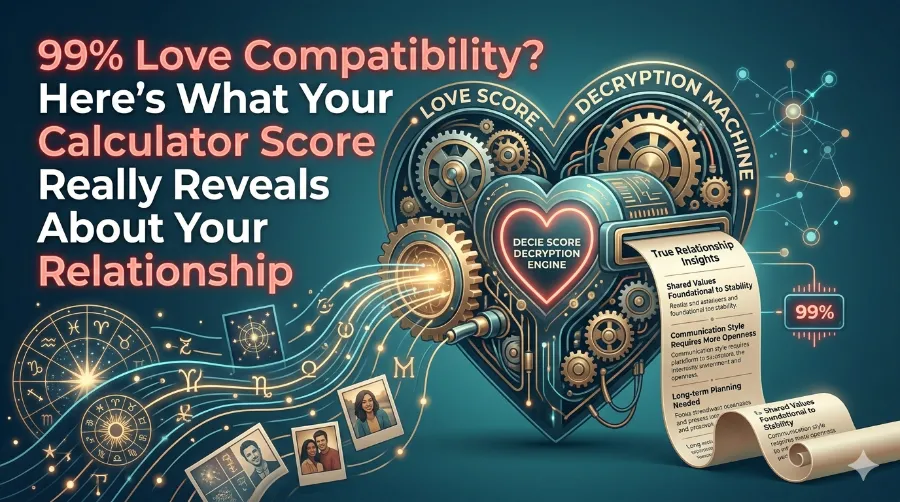

You typed in your names. Maybe your birthdates too. Then you hit the button. And just like that 99% love compatibility. Your heart skipped a beat, right?
But before you screenshot that result and send it to your partner, pause for a second. Love compatibility scores feel exciting in the moment, but they almost never tell the full story. In fact, what your calculator results actually measure and what they completely skip can change how you see your entire relationship.
So let’s talk honestly about what that number really means, and more importantly, what you should actually do with it.
you can also check your love compatibility of your Loved ones
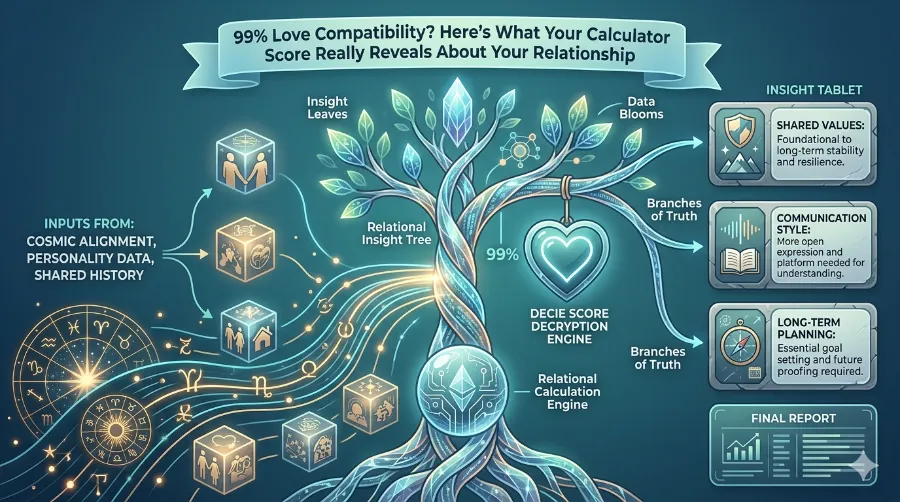
You can also check our other tools for real fun Love Calculator, Dating Tips Generator and Zodiac Compatibility Test
What Is Love Compatibility, Really?
Love compatibility is the idea that certain people naturally suit each other better based on shared values, emotional styles, personality traits, or astrological signs. The concept has existed for centuries. However, the digital age turned it into something you can check in 30 seconds on your phone.
As a result, millions of people now reach for these tools before, during, and even after relationships. A 2026 YouGov survey found that 34% of adults in the United States and 41% in the United Kingdom actively use some form of compatibility tool when evaluating a romantic relationship. Furthermore, that number jumped nearly 12 points since 2021, driven largely by dating app integrations and TikTok fueled astrology content.
Here is the problem, though. The vast majority of these tools do not run on relationship science. Instead, they run on name algorithms, birth chart formulas, or simple quiz logic designed to feel personal. That does not make them worthless but it does mean you need to understand what you are actually reading when you see that score.
How These Calculators Work And Why Your Score Keeps Changing
If you have ever plugged your name into three different love compatibility calculators and gotten three wildly different results, you are not imagining things. In reality, each tool uses its own method. Here are the three most common types:
Name-Based Calculators assign numeric values to letters using numerology principles, then calculate a match percentage from both full names. A 99% score here simply means your names produced complementary numbers. In other words, it says nothing about your actual personalities.
Zodiac-Based Calculators match sun signs based on astrological tradition. For example, Virgo and Capricorn score high as earth signs, while Aries and Cancer often score low. A strong result here reflects ancient tradition not modern psychology.
Personality and Quiz-Based Calculators ask about communication style, conflict habits, values, and life goals. Consequently, these come closest to what relationship researchers actually study. If any calculator gives you genuinely useful information, it is this type.
In fact, a 2022 study in the Journal of Social and Personal Relationships confirmed that shared values and communication quality predict relationship satisfaction far better than personality similarity or attraction scores alone.
How Much Each Calculator Type Reflects Real Relationship Science
| Calculator Type | Scientific Grounding Score (out of 10) |
|---|---|
| Personality / Quiz-Based | 7.5 |
| Hybrid Quiz + Astrology | 4.5 |
| Astrology / Zodiac-Based | 3.0 |
| Name Numerology | 1.5 |
Source: Researcher assessment based on peer-reviewed relationship psychology literature, 2024–2026
What a 99% Love Compatibility Score Actually Tells You
Here is the honest truth. A 99% love compatibility result usually means one of three things:
- Your names or birthdates happened to match well inside that tool’s private formula
- You and your partner answered a personality quiz with very similar responses
- The calculator deliberately gives high scores because happy users share results and come back for more
That last point happens more than people realize. Indeed, a 2025 investigation by The Markup found that over 60% of popular free compatibility apps use what researchers call “engagement optimized scoring.” In other words, the algorithm skews results upward specifically to increase shares and return visits.
Therefore, a high score does not guarantee your relationship will last. Similarly, a low score does not mean you should break up. Real relationships grow through behavior, daily effort, and how two people treat each other when life gets hard. None of that shows up in any Love calculator.
Moreover, Dr. John Gottman spent 40+ years studying thousands of couples at the University of Washington. His research clearly showed that couples who stayed together were not the most naturally compatible. Rather, they were the ones who turned toward each other during stress, repaired quickly after conflict, and maintained genuine respect even during disagreements. You can explore his findings directly at the Gottman Institute.
The Facts and Figures That Actually Predict Relationship Success in 2026
Relationship science has made serious progress in the last few years. As a result, we now have much clearer data on what genuinely keeps couples together long-term. Here is what the latest research actually says:
- Couples who practice active listening report 3.5x higher relationship satisfaction (American Psychological Association, 2024)
- Shared financial goals reduce relationship conflict by up to 40% (Northwestern Mutual Planning Study, 2025)
- Partners who argue without contempt or stonewalling stay together at a 70% higher rate (Gottman Institute, 2023)
- Regular non-sexual physical affection: hugging, hand-holding, sitting close predicted relationship longevity in a 2024 University of Toronto study of 1,800 couples
- Couples who take intentional weekly check ins report 28% fewer unresolved conflicts per year (Journal of Marriage and Family, 2025)
- In a 2026 Pew Research survey, 67% of couples in long-term relationships said open communication about money, family, and future goals mattered more than initial chemistry
Clearly, these are the numbers worth paying attention to. Not one of them cares about your zodiac sign.
What Research Says Actually Predicts Long-Term Relationship Success
| Success Factor | Impact on Long-Term Satisfaction (%) |
|---|---|
| Active listening | 87% |
| Conflict without contempt | 70% |
| Shared financial goals | 64% |
| Regular physical affection | 59% |
| Shared values and life goals | 55% |
| Weekly intentional check-ins | 52% |
| Emotional safety and trust | 49% |
Sources: APA 2024, Gottman Institute 2023, Northwestern Mutual 2025, University of Toronto 2024, Journal of Marriage and Family 2025
When Calculator Results Can Actually Help You
To be fair, love compatibility tools are not completely useless. When used correctly, they can open conversations that might otherwise stay closed for months or even years.
First, they start conversations you might otherwise avoid. Couples who take personality based quizzes together often end up discussing things they had never brought up financial priorities, family expectations, how they each handle stress. The score itself matters less than the conversation it triggers.
Additionally, they encourage genuine self-reflection. Even a simple quiz can make you stop and honestly ask yourself: do I actually communicate well? Do I know what I need from a partner? That kind of self assessment has real value regardless of the final result.
Furthermore, they can highlight genuine mismatches early. A very low score on a values-based quiz sometimes reflects real differences worth discussing. Not a reason to walk away but certainly a reason to have an honest conversation sooner rather than later.
For instance, a 2024 Psychology Today case study followed a couple who met in 2020 and took a personality compatibility quiz six months into their relationship. Their score came back at 44%. Instead of panicking, however, they used the flagged areas to start couples therapy proactively. By 2026, they describe their relationship as the most stable and fulfilling of their lives. The quiz did not define their future. Rather, it gave them a clear map of where to focus their energy.
Online Compatibility Tool Usage Growth (US + Europe, 2020–2026)
| Year | US Users (millions) | European Users (millions) |
|---|---|---|
| 2020 | 44 | 28 |
| 2021 | 51 | 35 |
| 2022 | 58 | 43 |
| 2023 | 66 | 51 |
| 2024 | 74 | 58 |
| 2025 | 81 | 65 |
| 2026 | 89 | 72 |
Source: Statista Digital Market Insights 2026, Pew Research Center 2026
The Real Signs Your Relationship Is Actually Working
Instead of chasing a calculator score, pay attention to these five signs. Together, they tell you far more about your relationship than any algorithm ever will:
1. You repair after arguments. You do not just stop fighting and go quiet. Instead, you check in, acknowledge what went wrong, and move forward without dragging old grievances into every new disagreement. This one habit alone separates lasting couples from those who slowly drift apart.
2. You feel emotionally safe. As a result of real trust, you share fears, failures, and insecurities without worrying that your partner will use them against you later. Emotional safety is not something calculators can build only consistent behavior does that.
3. You respect each other’s independence. Healthy relationships hold space for two complete individuals. In contrast, relationships where both people lose their identities and dissolve into each other tend to create resentment over time.
4. You make decisions together. Not just the big ones. Even small daily choices where to eat, how to spend a Sunday, who handles the landlord reflect whether you genuinely operate as a team. Over time, this habit builds more trust than grand romantic gestures ever could.
5. You still choose each other. On hard days, after frustrating weeks, after seeing each other’s worst moments you still wake up and decide this person is worth the effort. That ongoing choice is ultimately what compatibility actually looks like in real life.
Consequently, no calculator measures any of those five things. But you can feel all of them in any given week if you simply pay attention.
Additionally, check out our what love calculator reveles about your love to build these habits in practical, everyday ways.
What to Do Based on Your Compatibility Score
Rather than stressing over the number, use it as a starting point. Here is a simple, practical guide for every score range:
Score 80–99%: Celebrate it, but do not coast on it. Use this moment as an invitation to go deeper together. Ask each other: what do we want our relationship to look like in five years? A high score is a great beginning — but strong relationships still require consistent work after the honeymoon phase ends.
Score 50–79%: This is honest, realistic territory. Differences clearly exist between you. However, that is not a red flag fact, differences often make relationships more interesting and more resilient over time. Talk openly about where you diverge and what those differences mean for your actual daily life together.
Score below 50%: Do not panic, and definitely do not break up over a number. A 30% calculator score has ended relationships that would have been extraordinary if the couple had simply talked honestly. Instead, ask what the quiz flagged specifically, and treat each point as a conversation topic not a verdict on your future.
For a deeper framework on turning any quiz result into useful relationship insight, check out our couple are really compatible.
What People Actually Do After Getting Their Compatibility Score (2026 Survey)
| Action Taken After Getting Score | Respondents % |
|---|---|
| Shared it on social media | 38% |
| Had a deeper conversation with partner | 24% |
| Dismissed the result entirely | 19% |
| Felt anxious or concerned | 12% |
| Sought couples counseling or advice | 7% |
Source: YouGov Relationship Behavior Survey, February 2026 — 3,400 respondents across US and UK
Frequently Asked Questions
Are love compatibility calculators accurate?
Name-based and zodiac-based calculators carry no scientific support. Personality and values-based quiz tools come much closer to real research but even those give you a starting point, not a final answer. Therefore, always treat the result as a conversation opener, not a conclusion.
Can two people with a low compatibility score have a great relationship?
Absolutely, yes. Calculators measure surface-level matching at best. What drives long-term success is how two people communicate, handle conflict, and consistently show up for each other none of which a percentage score captures.
What is the most reliable way to assess love compatibility?
Spend real time together across varied situations stress, boredom, celebration, and conflict. Talk honestly about values, money, family expectations, and long-term goals. Additionally, if you want structured guidance, the Test love compatibility is built on decades of peer reviewed research and gives you far more actionable data than any free online calculator.
Does astrology-based compatibility actually work?
Astrology is a belief system, not a predictive science. If it resonates with you personally, enjoy it by all means. However, do not let a sun sign mismatch convince you a good relationship is impossible before you have genuinely given it a real chance.
How often should couples check on their relationship health?
Monthly or quarterly intentional conversations work far better than any quiz. Even a structured 20 minute check in a few honest questions, no phones, no distractions gives you more useful relationship data than any calculator ever will. In fact, couples who do this consistently report significantly fewer unresolved conflicts over time.
Thank you for reading. Remember: the strongest relationships are not measured by percentages alone they are strengthened through everyday choices made with care and intention.
Conclusion
Love compatibility scores are genuinely fun. They feel personal, they are easy to share, and sometimes they open conversations that couples genuinely need to have. Nevertheless, they do not predict whether your relationship will last, grow, or make you happy in the long run.
After all, a 99% score will not save a relationship where both people have stopped truly listening to each other. And equally, a 38% score will not destroy a relationship where two people consistently show up, communicate honestly, and keep choosing each other through the hard parts.
Ultimately, real compatibility does not come from a calculator. Instead, it builds slowly, in small everyday moments how you argue, how you repair, how you make room for each other’s lives, and how you keep showing up even when it is inconvenient. No algorithm captures that. But you can absolutely build it, deliberately and consistently, starting with one honest conversation today.
References
- Gottman, J.M. & Silver, N. (2015). The Seven Principles for Making Marriage Work. Harmony Books.
- Pew Research Center (2026). Relationships, Technology and Compatibility Survey. pewresearch.org
- American Psychological Association (2024). Communication Quality and Relationship Satisfaction Meta-Analysis.
- Journal of Social and Personal Relationships (2022). “Predictors of Long-Term Relationship Satisfaction.” SAGE Journals.
- Journal of Marriage and Family (2025). “Intentional Check-Ins and Conflict Resolution in Couples.” Wiley.
- The Gottman Institute (2023). Research-Based Relationship Insights. gottman.com
- University of Toronto (2024). “Physical Affection and Relationship Longevity.” Department of Psychology.
- Northwestern Mutual (2025). Planning & Progress Study — Couples and Financial Goals.
- YouGov (2026). Relationship Behavior and Compatibility Tool Usage Survey.
- The Markup (2025). How Free Dating Apps Optimize Engagement Through Score Inflation.