
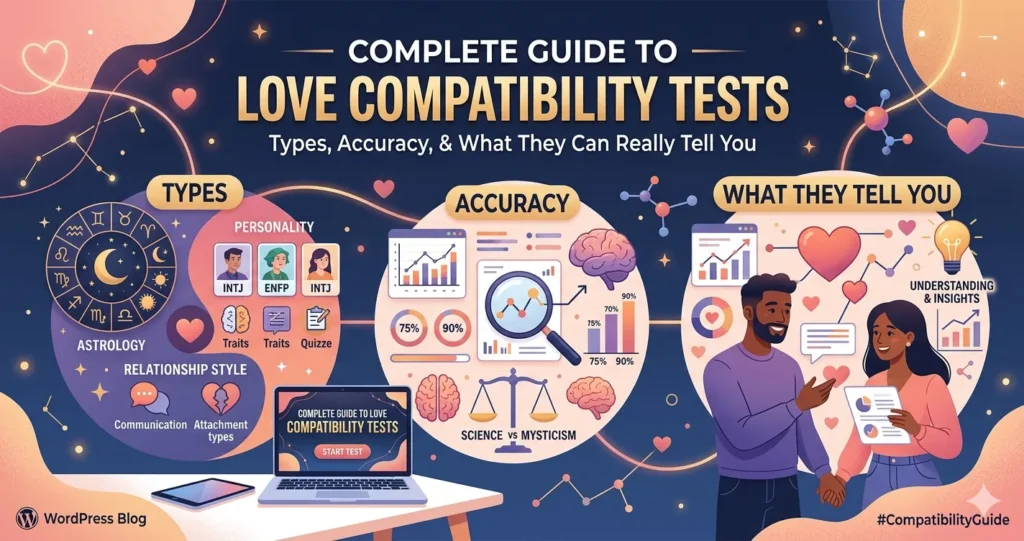

Have you ever entered two names into a love compatibility test and waited eagerly for the result? Whether the score made you smile, laugh, or question everything for a moment, you are certainly not alone.
Millions of people use love compatibility tests every year. Some take them out of curiosity after meeting someone new. Others try them with long-term partners simply for fun. Around occasions like Valentine’s Day, these tools become even more popular.
However, an important question often goes unanswered: What does a love compatibility test actually measure?
Can a simple percentage predict the future of a relationship? Is there any truth behind zodiac compatibility and numerology? Or are these tools designed purely for entertainment?
This guide explores the most common types of love compatibility tests, explains how they work, and discusses what their results can realistically tell you. By the end, you will have a clearer understanding of how to interpret compatibility scores and how to use them in a healthy, balanced way.

What Is a Love Compatibility Test?
A love compatibility test is a tool designed to estimate how well two individuals may connect romantically. Depending on the type of test, it may use information such as:
- Names
- Birth dates
- Zodiac signs
- Personality traits
- Relationship preferences
After processing the information, the tool provides a compatibility result, often displayed as a percentage score between 0% and 100%.
Although modern compatibility calculators are available online, the concept itself is not new. For decades, people have explored relationship compatibility through astrology, numerology, personality assessments, and even simple name-based games.
It is essential to understand that no compatibility test can determine whether a relationship will succeed or fail. Healthy relationships depend on communication, trust, mutual respect, and consistent effort from both partners.
Nevertheless, compatibility tests can still serve a useful purpose. They often encourage self-reflection, spark meaningful conversations, and provide a fun way to explore different aspects of romantic relationships.
Why Are Love Compatibility Tests So Popular?
Several factors contribute to the enduring popularity of these tools.
They Are Easy to Use
Most compatibility tests require only a few pieces of information. In many cases, users can receive results within seconds.
They Encourage Conversation
Couples frequently use compatibility tests as conversation starters. Discussing the results can lead to deeper insights about expectations, communication styles, and personal values.
They Offer Entertainment
Many people simply enjoy the experience. Sharing scores with friends or partners adds an element of excitement and playfulness.
They Promote Self-Awareness
Certain compatibility assessments, particularly personality-based tests, encourage individuals to reflect on their behaviors, emotional needs, and relationship patterns.
The Main Types of Love Compatibility Tests
Not all compatibility tests work in the same way. Understanding their differences can help you decide which approach aligns best with your interests.
1. Name-Based Love Compatibility Tests
These are among the most widely used love calculators online.
Users enter two names, and the system generates a compatibility percentage using a predefined algorithm. The exact formulas vary from one calculator to another, but they typically assign numerical values to letters and combine them to produce a score.
Advantages
- Quick and simple
- Free to use
- Highly entertaining
- Easy to share with friends
Limitations
- Results may change depending on spelling variations or nicknames
- No scientific foundation
- Intended primarily for entertainment purposes
If you are looking for a lighthearted experience, a love compatibility calculator can be a fun place to begin.
Internal Link Suggestion:
Learn more through our Love Calculator Tool at Toolshubb.
2. Zodiac Compatibility Tests
Astrology-based compatibility tests compare individuals according to their zodiac signs.
In Western astrology, the twelve signs belong to four elements:
- Fire: Aries, Leo, Sagittarius
- Earth: Taurus, Virgo, Capricorn
- Air: Gemini, Libra, Aquarius
- Water: Cancer, Scorpio, Pisces
Astrologers believe these elements influence personality traits and relationship dynamics.
For example:
- Fire and Air signs are often viewed as energetic and stimulating combinations.
- Earth and Water signs are frequently associated with stability and emotional depth.
Advantages
- Rooted in long-standing traditions
- Encourages reflection on personality differences
- Popular among astrology enthusiasts
Limitations
- Not supported by scientific evidence
- Oversimplification may overlook individual complexity
Many people still find zodiac compatibility readings meaningful because they provide language for discussing emotional tendencies and interpersonal styles.
Internal Link Suggestion:
Explore your results using the Zodiac Compatibility Test available on Toolshubb.
3. Numerology Love Tests
Numerology focuses on the symbolic significance of numbers derived from birth dates.
One of the most common methods involves calculating a person’s Life Path Number. Numerologists believe these numbers reveal important aspects of personality, strengths, and relationship tendencies.
Compatibility is then assessed by examining how two Life Path Numbers interact.
Advantages
- Based on fixed birth information
- Provides structured interpretations
- Appeals to those interested in spiritual traditions
Limitations
- Lacks scientific validation
- Interpretations may vary among practitioners
Despite these limitations, many individuals appreciate numerology as a tool for personal exploration and relationship reflection.
Internal Link Suggestion:
Try the Numerology Love Test to discover your Life Path compatibility.
4. Personality-Based Compatibility Tests
Among all types of compatibility assessments, personality-based tests are generally considered the most practical. Instead of focusing on names, birth dates, or zodiac signs, these tests explore how individuals think, communicate, and behave within relationships.
Typical questions may include:
- How do you respond during disagreements?
- Do you need frequent reassurance from your partner?
- How comfortable are you with emotional intimacy?
- Do you prefer independence or constant togetherness?
- How do you express affection and appreciation?
The goal is not to predict the future. Rather, these assessments aim to increase awareness of personal tendencies and relationship patterns.
Why Personality Matters in Relationships
Research in relationship psychology consistently shows that compatibility extends beyond shared interests. Factors such as emotional regulation, communication habits, and conflict resolution styles often play a more significant role in long-term relationship satisfaction.
Two people can have different personalities and still build a healthy partnership if they understand each other’s needs and approach differences with empathy and respect.
The Role of Attachment Theory
One of the most widely discussed frameworks in modern relationship psychology is attachment theory.
According to attachment theory, early experiences may influence how people connect emotionally with romantic partners later in life. Although attachment styles can evolve over time, they often shape expectations and behaviors within relationships.
The four commonly discussed attachment styles include:
Secure Attachment
Individuals with a secure attachment style generally feel comfortable with both closeness and independence.
Common characteristics include:
- Open communication
- Emotional availability
- Trust in relationships
- Healthy conflict resolution
Anxious Attachment
People with anxious attachment tendencies often seek reassurance and may worry about abandonment.
Common characteristics include:
- Fear of rejection
- Sensitivity to changes in communication
- Strong desire for emotional closeness
Avoidant Attachment
Avoidant individuals often value independence and may struggle with vulnerability.
Common characteristics include:
- Discomfort with excessive emotional dependence
- Preference for personal space
- Difficulty expressing deeper feelings
Disorganized Attachment
This attachment style may involve conflicting desires for intimacy and distance.
Common characteristics include:
- Inconsistent relationship behaviors
- Difficulty trusting others
- Fear of emotional closeness combined with fear of separation
Understanding attachment styles can help couples identify recurring patterns and improve communication.
Internal Link Suggestion:
If you want guidance based on your compatibility results, explore Toolshubb’s Relationship Advice Generator for additional insights.
5. Synastry and Full Birth Chart Compatibility
While basic zodiac compatibility compares Sun signs, synastry takes a more detailed approach.
A synastry reading examines the positions of multiple astrological placements, including:
- Sun signs
- Moon signs
- Rising signs
- Venus placements
- Mars placements
- Planetary aspects
Supporters believe this method offers a more comprehensive understanding of romantic dynamics than simple Sun sign comparisons.
Potential Benefits
- Encourages deeper reflection
- Explores multiple personality dimensions
- Appeals to those interested in advanced astrology
Important Limitations
- Interpretations vary considerably among astrologers.
- Scientific evidence supporting predictive accuracy remains limited.
For many individuals, synastry serves as a meaningful framework for self-discovery rather than a definitive guide to relationship success.
How Accurate Are Love Compatibility Tests?
This is perhaps the most common question people ask.
The honest answer is simple:
Accuracy depends entirely on the type of compatibility test you choose.
A name-based love calculator and a personality assessment operate on completely different principles. Therefore, their results should not be interpreted in the same way.
Comparing Different Compatibility Tests
| Test Type | Entertainment Value | Insight Potential | Scientific Support |
|---|---|---|---|
| Name-Based Tests | Very High | Low | No |
| Zodiac Compatibility | High | Moderate | Limited |
| Numerology Tests | Moderate to High | Moderate | Limited |
| Synastry Analysis | Moderate | Moderate to High | Limited |
| Personality Assessments | Moderate | High | Stronger Research Foundation |
Name Based Love Tests
These calculators are best viewed as entertainment tools.
While they can be enjoyable and conversation-starting, they should never influence serious relationship decisions.
Zodiac and Numerology Tests
These approaches draw upon traditions that have existed for centuries.
Many users report that the descriptions resonate with their experiences. However, modern scientific research has not confirmed their ability to predict relationship outcomes.
Personality Assessments
Among compatibility tools, personality-based evaluations offer the strongest evidence-based insights.
They cannot guarantee relationship success. However, they may help individuals understand communication preferences, emotional needs, and areas requiring growth.
What Love Compatibility Tests Can Actually Tell You
Used thoughtfully, compatibility tests can offer several benefits.
1. They Encourage Self-Reflection
Results sometimes highlight patterns people have never consciously considered.
For example:
- Do you avoid difficult conversations?
- Do you frequently seek reassurance?
- Are you prioritizing compatibility over communication?
Greater self-awareness often leads to healthier relationship choices.
2. They Start Important Conversations
Discussing compatibility results with a partner can create opportunities for deeper dialogue.
Topics may include:
- Future expectations
- Emotional needs
- Communication styles
- Shared values
Even if you disagree with the results, the conversation itself may prove valuable.
3. They Promote Curiosity About Relationships
Many people use compatibility tools as an introduction to broader relationship concepts.
Exploring topics such as attachment styles, conflict resolution, and emotional intelligence can contribute positively to personal growth.
4. They Add Fun to Relationships
Not every relationship activity must be serious.
Taking a compatibility test together can provide moments of laughter, curiosity, and connection.
Sometimes, the shared experience matters more than the actual score.
What Love Compatibility Tests Cannot Tell You
Understanding limitations is equally important.
A compatibility percentage cannot measure:
- Commitment
- Trustworthiness
- Kindness
- Emotional maturity
- Respect
- Shared life goals
- Willingness to grow together
These factors develop through real experiences and everyday choices.
No algorithm can fully capture the complexity of human relationships.
Likewise, a low compatibility score does not automatically indicate relationship problems.
Healthy relationships are built intentionally through communication, understanding, and mutual effort.
A number on a screen should never determine whether a relationship deserves a chance.
Expert Perspective on Relationship Success
Relationship researchers frequently emphasize behaviors over compatibility scores.
Healthy partnerships often demonstrate qualities such as:
- Effective communication
- Mutual respect
- Emotional responsiveness
- Conflict repair skills
- Shared commitment to growth
These characteristics require practice and intentional effort from both individuals.
Compatibility may influence attraction and ease of connection. However, relationship satisfaction depends heavily on how couples navigate challenges together.
In other words:
Compatibility may open the door, but daily choices determine what happens after that.
Real-Life Compatibility Scenarios: What the Scores Don’t Show
One of the biggest mistakes people make is treating a compatibility score as a prediction. In reality, the success of a relationship depends on much more than a percentage.
The following examples illustrate why context always matters.
Scenario 1: Low Score, Strong Relationship
Emma and Noah score 41% on a love compatibility test.
At first glance, the result seems disappointing. However, their relationship tells a different story.
They communicate openly about their feelings. They support each other through difficult times. When disagreements happen, they work together to find solutions instead of assigning blame.
Five years later, they continue to build a healthy and fulfilling relationship.
What This Teaches Us
A lower compatibility score does not automatically indicate an unhealthy relationship.
Qualities such as:
- Trust
- Emotional support
- Respect
- Consistent communication
often matter far more than the outcome of an online calculator.
Scenario 2: High Score, Relationship Challenges
Sophia and Liam receive a 96% compatibility result.
The score feels reassuring.
However, over time they struggle with unresolved conflicts. Difficult conversations are avoided. Small frustrations accumulate until resentment begins to affect the relationship.
Despite their impressive compatibility percentage, the relationship eventually ends.
What This Teaches Us
A high compatibility score cannot compensate for:
- Poor communication
- Lack of accountability
- Emotional disconnection
- Unwillingness to address problems
Strong relationships require intentional effort regardless of initial compatibility.
Which Love Compatibility Test Should You Try First?
The answer depends on what you hope to gain from the experience.
If You Want Something Fun and Quick
Start with a Name-Based Love Compatibility Test.
These tools are entertaining, easy to use, and perfect for casual curiosity.
Best For:
- First-time users
- Friends sharing results
- Couples looking for a playful activity
Try: Toolshubb’s Love Compatibility Calculator.
If You Enjoy Astrology
Explore a Zodiac Compatibility Test.
Astrology enthusiasts often appreciate the personality insights and relationship themes associated with different zodiac combinations.
Best For:
- Astrology followers
- People interested in personality archetypes
- Couples curious about astrological dynamics
Try: Toolshubb’s Zodiac Compatibility Tool.
If You Prefer Numerology
A Numerology Love Test may provide a unique perspective.
Life Path Numbers encourage reflection on strengths, motivations, and potential relationship patterns.
Best For:
- Numerology enthusiasts
- Individuals interested in spiritual traditions
- Couples seeking alternative perspectives
Try: Toolshubb’s Numerology Love Calculator
If You Want Meaningful Relationship Insights
Choose a Personality-Based Compatibility Assessment.
These tests often provide the most practical information because they focus on communication habits, emotional needs, and interpersonal styles.
Best For:
- Long-term couples
- Individuals focused on personal growth
- People seeking actionable relationship insights
Consider: Exploring attachment theory resources alongside your results.
How to Use Love Compatibility Results in a Healthy Way
Compatibility tools work best when approached with realistic expectations.
Use Results as Conversation Starters
Instead of treating scores as facts, use them as opportunities to discuss important topics.
Questions you might ask include:
- What qualities matter most to us in a relationship?
- How do we handle disagreements?
- What helps each of us feel appreciated?
- What areas could we improve together?
Focus on Patterns, Not Predictions
If a personality assessment highlights communication challenges, consider whether those patterns resonate with your experiences.
Reflection can lead to growth.
Prediction, however, should never replace thoughtful decision-making.
Avoid Major Decisions Based Solely on Scores
Ending a relationship because of a compatibility percentage is rarely wise.
Likewise, staying in an unhealthy relationship simply because a calculator shows a high score can be equally problematic.
Real relationships require ongoing effort and honest evaluation.
Explore Toolshubb’s Free Love Tools
Whether you’re looking for entertainment or relationship insights, Toolshubb offers several free tools designed to make compatibility exploration enjoyable and accessible.
Available Love Tools
❤️ Love Compatibility Calculator
Discover your compatibility score by entering two names.
⭐ Zodiac Compatibility Test
Explore how different zodiac signs interact in romantic relationships.
🔢 Numerology Love Test
Calculate Life Path Numbers and uncover potential relationship patterns.
💬 Relationship Advice Generator
Receive practical ideas and prompts designed to encourage healthier communication and stronger connections.
Why Users Choose Toolshubb
- Completely free to use
- No registration required
- Instant results
- Mobile-friendly experience
- Simple and intuitive interface
Frequently Asked Questions
What is a love compatibility test?
A love compatibility test is a tool designed to estimate romantic compatibility between two individuals using information such as names, birth dates, zodiac signs, or personality traits.
Results are generally presented as a percentage score or descriptive interpretation.
Are love compatibility tests scientifically accurate?
Scientific support varies depending on the type of test.
Name-based calculators are primarily entertainment tools.
Personality assessments rooted in psychological frameworks often provide more evidence-based insights related to communication styles and relationship tendencies.
No compatibility test can predict the future of a relationship with certainty.
Can a compatibility test determine whether a relationship will succeed?
No.
Long-term relationship success depends on factors such as communication, trust, emotional maturity, shared values, and mutual commitment.
These qualities cannot be fully measured through an online calculator.
Which compatibility test is the most reliable?
If your goal is self-awareness and practical relationship insight, personality-based assessments generally offer the greatest value.
If you’re seeking entertainment, name-based, zodiac, and numerology tests can still provide enjoyable experiences and meaningful conversations.
Is a low compatibility score a bad sign?
Not necessarily.
A lower score does not mean a relationship is doomed.
Healthy relationships are strengthened through empathy, communication, compromise, and consistent effort over time.
Should I make relationship decisions based on compatibility scores?
No.
Compatibility tests should complement thoughtful reflection rather than replace it.
Important relationship decisions should always consider the broader realities of the partnership.
Conclusion: Compatibility Is Only Part of the Story
Love compatibility tests continue to capture people’s interest because relationships matter deeply to all of us.
Whether you are exploring astrology, numerology, personality assessments, or simply trying a love calculator for fun, these tools can encourage reflection and meaningful conversations.
At the same time, it is important to recognize their limitations.
No percentage score can fully define the strength of a relationship.
Healthy partnerships are built through:
- Honest communication
- Mutual respect
- Patience during challenges
- Emotional support
- A shared willingness to grow together
Compatibility may influence attraction and understanding. However, the future of a relationship depends largely on the choices two people make every day.
Enjoy love compatibility tests for what they truly are: opportunities to learn more about yourself, connect with others, and perhaps start conversations that matter.
Because in the end, relationships are shaped less by numbers and far more by the care, effort, and commitment people bring to them each day.