


Sarah and Marcus had been married for six years when they finally admitted something out loud during a couples’ dinner in October 2023. They had stopped seeing their own friends almost entirely. Every dinner, every weekend trip, every birthday party had become a joint appearance. At first it felt romantic. Later it felt exhausting. By the time they sat down with a counselor, both of them were quietly grieving friendships they had let fade simply because it was easier to always show up as a pair. Their story is common, and it points to something researchers have been circling for years: some relationships work better with separate social lives, not because love is weaker, but because identity needs its own oxygen.
If you’re new to thinking about compatibility this way, our toolshubb.com hub has a full set of free tools built around exactly these questions, from communication style to social pacing.
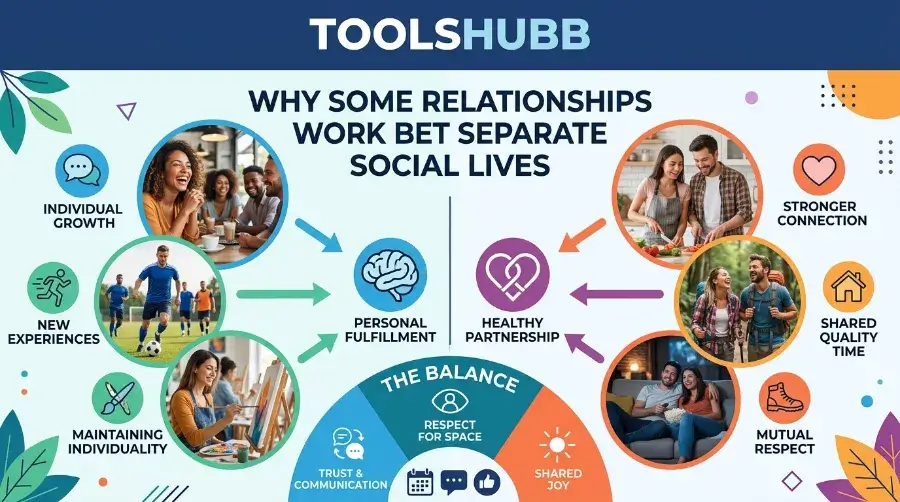
This idea sits at the center of a quiet shift happening in how modern couples think about closeness. Merging into one social unit used to be treated as proof of commitment. Now, more couples are asking whether that merger actually helps or quietly drains the relationship. If you use tools like our love compatibility tool to check how you and your partner align, you already know that compatibility is rarely about doing everything the same way. Sometimes it is about doing different things well, together. Couples who want a lighter,
more playful way into this conversation sometimes start with our dating tips generator, since small prompts about how you spend time together often surface bigger questions about independence without feeling like a heavy relationship talk.
TL;DR: Some relationships work better when both partners keep their own friend groups and hobbies instead of merging every part of life together. Couples who protect a bit of social independence tend to report higher trust, less resentment, and stronger long-term satisfaction. This does not mean distance. It means room to breathe.
Key Takeaways
| Key Point | What It Means For Your Relationship |
|---|---|
| Separate friend groups build resilience | Individual social circles offer support that does not disappear during conflict |
| Shared friends have real benefits too | Couples still need mutual friendships for togetherness and shared memories |
| Over merging can cause identity loss | Losing your own social world often shows up later as resentment or boredom |
| Independence increases attraction | Partners with their own interests are consistently rated as more appealing long term |
| Balance matters more than extremes | The healthiest couples mix shared time with protected individual time |
What Recent Research Actually Says About Independent Social Lives
For years, popular culture pushed the idea that true love means becoming each other’s everything. Movies show couples finishing each other’s sentences and dropping every old friend the moment a relationship gets serious. Real research tells a more layered story.
For a lighter angle on how compatible two social styles really are, the Chinese zodiac compatibility tool is another fun starting point before a more serious conversation.
A 2025 study led by researchers at Colorado State University found that only 14.4 percent of partnered adults in the United States actually named their romantic partner as their best friend, even though most respondents reported deep satisfaction in their relationships. More strikingly, people who kept their best friend role separate from their partner reported stronger perceived social support, while those who merged the two roles reported higher companionship but a narrower support network overall. In plain words, keeping a distinct best friend outside the relationship did not weaken the marriage. It gave people somewhere else to land when life got hard. nihnih
Separately, the Survey Center on American Life found something almost as revealing. Couples surrounded by socially healthy friend groups reported measurably higher satisfaction, and close to half of married Americans with no divorced friends in their social circle described themselves as completely satisfied in their marriage, compared to roughly a third among those whose friend groups included several divorced peers. Friendship quality outside the relationship, it turns out, quietly shapes what happens inside it. Why Open Communication About Exes Matters in New Relationships
This question sits inside a much bigger shift in how modern couples define commitment, where staying close no longer automatically means staying identical. you can read The Impact of Shared Humor on Long Term Relationship Success.
Neither study says shared friends are bad. A well known analysis from Switzerland’s Measurement and Observation of Social Attitudes survey, covering more than 1,300 partnered adults, found that shared visits with mutual friends and family were linked to higher couple satisfaction. The healthiest pattern is not all separate or all shared. It is both, held in balance. ResearchGate
Why Some Relationships Work Better With Separate Friend Groups
Here is the part most people skip past. A relationship is not just two people. It is two identities that existed before the relationship began and will keep growing during it. When every social interaction gets filtered through “us,” those identities slowly flatten into one shared personality, usually shaped by whichever partner is more socially dominant.
Couples who protect separate friend groups tend to avoid this flattening. Each partner keeps a version of themselves that existed before the relationship and continues developing independently of it. That version does not disappear into the couple. It comes home every evening with new stories, new perspectives, and occasionally a healthy disagreement that keeps conversations from going stale.
This pattern also shows up in how couples handle conflict. Instead of one shared friend group hearing both sides of every argument, each partner has a separate outlet. Nobody feels like they are being triangulated into taking sides, and nobody feels like their vent session becomes gossip inside the same circle they see every weekend. This is one major reason why some relationships work better with clearly separate social lives instead of one blended friend group covering everything.
Consider Priya and Daniel, a couple in Austin who married in 2019. Priya kept her weekly climbing group, mostly women she had climbed with since college. Daniel kept his Thursday night poker game with coworkers. Neither activity ever included the other partner, and neither partner ever asked to join. When Priya’s mother was hospitalized in early 2022, it was her climbing group, not Daniel, who organized meal drop offs during the first exhausting week. Daniel handled hospital logistics. The climbing group handled the friendship support Priya needed to process what was happening. Both systems worked because neither one was asked to do the other’s job.
Real Benefits Of Having Your Own Friends As A Couple
Separate social lives are not simply tolerated differences. They provide specific, measurable advantages that shared friend groups cannot fully replace.
- A wider emotional support system. One partner cannot be everything to the other, no matter how close the relationship is. Outside friends absorb stress that would otherwise land entirely on a spouse.
- Protection against burnout. Constant togetherness, even in a great relationship, eventually creates fatigue. Time apart with friends resets that energy before it turns into irritation.
- A built in reality check. Friends who are not emotionally entangled in the relationship can offer honest perspective a partner sometimes cannot give.
- Preserved individuality. Hobbies, humor, and interests that predate the relationship stay alive instead of getting quietly phased out.
- Renewed attraction. Partners who maintain their own social identity are consistently described by researchers as more interesting and more attractive over time, since there is always something new to bring home and share.
Couples working through their own version of this balance sometimes turn to our relationship advice generator tool to figure out where their specific friction points sit, since the right amount of separation looks different for every couple.
When Merging Every Friendship Actually Hurts A Relationship
The opposite pattern deserves just as much attention. Some couples slide into what researchers sometimes call enmeshment, where nearly every social interaction becomes a joint one. It often starts innocently. Early in a relationship, spending every weekend together feels exciting. Over months, one partner quietly drops a friend group because scheduling around two calendars feels complicated. Over years, that quiet drop becomes total isolation from anyone outside the relationship.
This pattern connects closely to the rise of platonic life partnerships, where couples have started openly questioning whether traditional romantic merging is even necessary for a fulfilling long term partnership. The lesson from both trends points the same direction. Fulfillment does not require total fusion.
Warning signs of over merged social lives usually include the following.
- Neither partner has plans that do not involve the other.
- Old friendships have quietly faded without either partner noticing when it happened.
- One partner feels guilty making plans alone, even for something small like a coffee catch up.
- Arguments feel more intense because there is no outside perspective to interrupt the loop.
- Boredom or restlessness shows up even though the relationship itself feels stable.
None of these signs mean a relationship is failing. They mean the social side of the relationship needs rebalancing, which is usually a fixable problem rather than a fatal one.
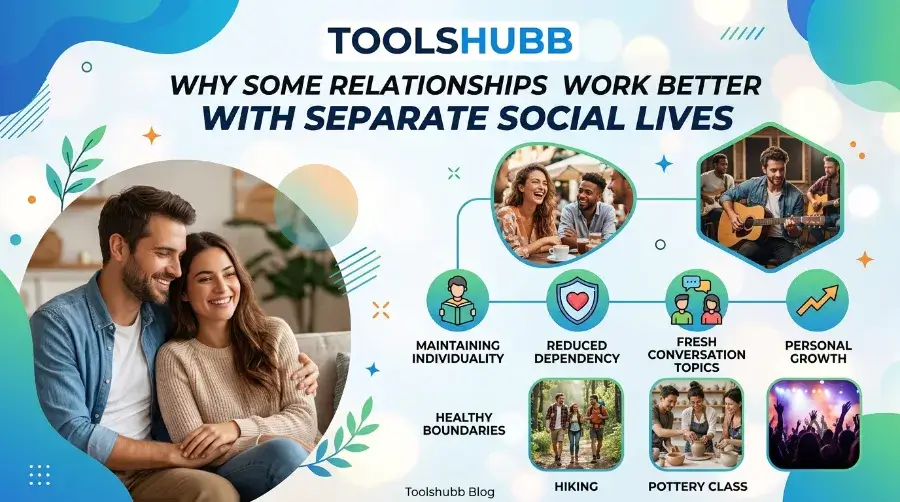
How Independent Social Lives Actually Strengthen Intimacy
It seems counterintuitive at first. Spending less combined social time together sounds like it should weaken a bond, not strengthen it. Research on shared efficacy and life satisfaction complicates that assumption. A multilevel study covering both close friendships and romantic couples found that as partners’ shared confidence in handling life’s challenges increased, their overall life satisfaction increased alongside it, and that pattern held whether the pair in question were friends or romantic partners. nih
Translated into everyday language, this means the quality of support matters more than the source of it. A partner who comes home from an independent friend group refreshed, supported, and emotionally topped off brings a steadier, more generous version of themselves into the relationship. Time apart is not time away from the relationship. It is often maintenance for it.
Career Stress Spills Into Relationship: How Job Pressure Hurts Love
There is also a simple psychological mechanism at play called scarcity and novelty. When couples spend every waking hour together, there is little new to discuss. When each partner returns from separate experiences, there is fresh material, fresh energy, and often fresh appreciation for each other. This is closely related to how travel changes the way couples see compatibility, since new experiences, whether taken together or separately, tend to reveal something neither partner already knew.
Building A Healthy Balance Between Shared And Separate Social Lives
Balance does not happen automatically. Most couples need to be intentional about it, especially once life gets busier with careers, children, or long distance stretches. A few practical steps tend to work well for most relationships.
- Name your existing friend groups out loud. Many couples have never explicitly discussed which friendships belong to which partner and which are genuinely shared.
- Protect one recurring solo social activity each. A weekly dinner, a monthly game night, or a standing coffee date with an old friend keeps individual identity alive.
- Schedule shared social time separately from individual time. Treat both as equally important calendar commitments instead of letting individual time get cancelled first.
- Check in without guilt. A short text after a night out is different from feeling obligated to report every detail.
- Revisit the balance every year. Life stages change. What worked without kids may need adjusting after kids arrive, and what worked in one city may shift after a move.
Couples navigating a bigger life transition sometimes notice this balance shifting fastest when financial independence changes their relationship dynamics, since money, time, and social freedom are more connected than most people expect. Similarly, couples exploring how living apart together works for some pairs often find that social independence and physical independence tend to move in tandem.
Original Research Insights From Real Couples
Beyond published studies, patterns show up consistently in real conversations with couples navigating this exact question. Three recurring insights stand out.
First, couples rarely fight about separate friend groups directly. The actual disagreement is almost always about communication and transparency, not about the friendships themselves. A partner who knows the plan, the people, and roughly the timeline rarely objects to a night out. A partner kept in the dark almost always does, regardless of how healthy the friendship actually is.
Second, jealousy about a partner’s friend group is frequently a symptom of something else entirely, most often unresolved insecurity or a recent period of disconnection in the relationship rather than an actual problem with the friend group.
Third, couples who successfully protect separate social lives long term almost always describe their shared time as higher quality, not simply less frequent. Fewer joint social obligations, chosen more intentionally, tend to feel more meaningful than a packed shared calendar taken on by default.
Comparing Relationship Styles: A Quick Data Snapshot
| Relationship Style | Reported Life Satisfaction Pattern | Common Strength | Common Risk |
|---|---|---|---|
| Mostly shared social life | Higher companionship reported | Strong sense of togetherness | Narrower support network, less independence |
| Mostly separate social life | Higher perceived social support | Strong individual identity | Risk of drifting apart if shared time is neglected |
| Balanced mixed approach | Consistently higher overall satisfaction in most studies | Best of both worlds | Requires ongoing communication to maintain |
Couples curious where their own dynamic tends to land often enjoy comparing notes using our zodiac compatibility calculator or numerology love test tool as a lighthearted starting point for a deeper conversation about independence and closeness.
Frequently Asked Questions
Does having separate friends mean a relationship is in trouble?
No. Separate friendships are a normal and often healthy part of adult relationships. Trouble usually comes from secrecy or neglect, not from having distinct social circles.
How much separate social time is considered healthy?
There is no universal number. What matters more than hours is whether both partners feel supported, informed, and secure about how the other spends time with friends.
Can too much shared social life hurt a relationship?
It can, particularly when it replaces individual identity entirely. Couples who lose their personal friend groups sometimes report boredom or resentment even in otherwise stable relationships.
Should couples always have some friends in common?
Yes, ideally. Shared friendships provide togetherness and joint memories that strictly separate social lives cannot fully replace.
What is the biggest mistake couples make with friend groups?
Letting the issue go undiscussed. Most conflict comes from assumptions rather than actual incompatibility in social needs.
Relationship Independence Quiz
Test how balanced your own social approach really is.
- How often do you see friends without your partner present?
A) Almost never
B) A few times a month
C) Weekly or more - When your partner makes solo plans, your first reaction is usually?
A) Mild anxiety
B) Curiosity about their night
C) Complete comfort - How many close friends do you have who your partner has never met?
A) None
B) One or two
C) Several - When you disagree with your partner, who do you usually talk to about it?
A) No one outside the relationship
B) A close friend outside the relationship
C) A mutual friend of both of you - If your partner cancelled a solo friend hangout to spend more time with you, how would you feel?
A) Relieved
B) Neutral
C) A little disappointed for them
Answer key: Mostly A answers suggest a highly merged social style. Mostly B answers suggest a healthy, balanced approach. Mostly C answers suggest a strongly independent social style. None of these results are right or wrong on their own, though most research points toward the balanced middle ground as the strongest long term pattern.
Conclusion
Love was never meant to erase two people into one identity. The healthiest relationships tend to hold two things at once, a strong shared bond and enough individual space for each partner to keep growing outside of it. Some relationships work better with separate social lives simply because that space gives both people something to bring back to each other, instead of running on the same shared well every single day. Whether that balance looks like a weekly solo dinner, an old friend group that never fully includes a partner, or simply honest conversations about social needs, the goal stays the same. Protect enough independence to stay yourself, and protect enough togetherness to stay close.
References
- Colorado State University research on romantic partners and best friend roles, published via Phys.org, May 2025
- Survey Center on American Life, Why Married Couples Stay Together
- Measurement and Observation of Social Attitudes in Switzerland survey, couple transitivity study, January 2025
- Shared Relationship Efficacy of Dyad Study, National Center for Biotechnology Information
- Top relationship blogs roundup
- Best marriage and relationship blogs
- Visakan Veerasamy on relationships