
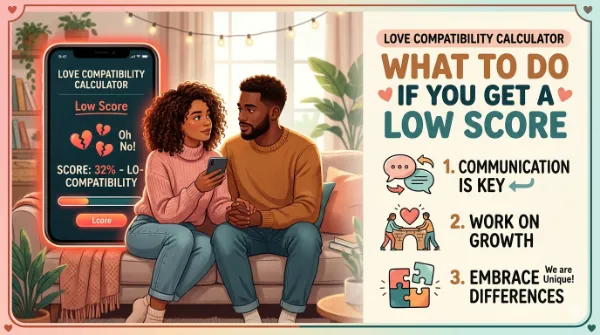

So you typed in your name and your partner’s name, hit the button, and… ouch. A low number stared back at you. Before you start panicking or Googling “are we doomed,” take a breath. A love compatibility calculator is a fun little tool, but it is not a fortune teller, and it definitely does not have the final say on your relationship.
In this guide, we will break down what these scores actually mean, why a low number is not a red flag in real life, and what you can do next if you want to build something stronger. We will also look at real research from relationship experts, because numbers from actual studies matter a lot more than numbers from an online quiz.
What Is a Love Compatibility Calculator, Really?
A love compatibility calculator is an online tool that uses names, birthdates, or zodiac signs to generate a percentage score. Some versions rely on numerology, where letters in your name are converted into numbers. Other versions use astrology, comparing zodiac signs and elements like fire, earth, air, and water.
Either way, the goal is simple: give you a quick, playful snapshot of how two people might “match” on paper. Many tools also offer a deeper relationship compatibility breakdown, splitting results into categories such as emotional connection, communication style, and long-term potential.
However, it’s important to remember these calculators were originally built for entertainment. Because of that, two different tools can give two completely different results for the same couple, and that’s perfectly normal.
Compatibility Score Meaning: Breaking Down the Numbers
Understanding compatibility score meaning helps take the sting out of a disappointing result. Generally, most calculators follow a similar pattern:
- 90 to 100 percent: Often labeled as a strong match, suggesting ease and natural rhythm between two people.
- 70 to 89 percent: A solid score that points to good potential, though some effort is still expected.
- 40 to 69 percent: A medium range that simply reflects more differences than similarities in the formula.
- Below 40 percent: Often described as a low score, meaning the calculator detected more contrast than overlap in its inputs.
Here’s the part that matters most: medium and even low scores are extremely common, and they often describe relationships that work just fine in real life. A numerology or astrology percentage cannot measure things like trust, shared history, or how someone shows up for you during a hard week.
What Does a Low Love Score Mean?
So, what does low love score mean in practical terms? Honestly, not much. A low percentage usually just means the formula found less overlap between the numbers or symbols linked to your names or birthdates. That’s it. It is not a measurement of your feelings, your effort, or your future together.
Think of it this way: if you ran the same names through five different calculators, you would likely get five different scores. That alone tells you the number reflects an algorithm’s quirks, not your actual bond.
Real Couples, Real Differences
Consider this scenario. A couple celebrating their tenth wedding anniversary in March 2026 might enter their names into a popular calculator and get a 38 percent match. Meanwhile, a couple who just started dating last month might score 91 percent. Does that mean the newer couple is more compatible? Not necessarily, and most long-married couples would laugh at the idea.
What actually predicts whether a relationship lasts has been studied for decades by real researchers, and the findings look nothing like a numerology chart.
Why Real Relationship Science Tells a Different Story
According to research from the Gottman Institute, which followed more than 3,000 couples over several decades, the strongest predictors of relationship success are communication patterns, not numbers tied to a name. Couples who stayed together responded to small bids for connection 86 percent of the time, while couples who later divorced did so only 33 percent of the time. Connectedcouples
That’s a massive difference, and notice that it has nothing to do with astrology or numerology. It comes down to everyday habits, like noticing when your partner mentions something interesting and engaging with it instead of scrolling past.
Gottman’s research also identified four communication patterns that predict relationship trouble: criticism, contempt, defensiveness, and stonewalling, often called the Four Horsemen. Of these, contempt tends to do the most damage because it signals a lack of respect. Connectedcouples
On a more hopeful note, therapy genuinely works for many couples. Research published in the Journal of Marital and Family Therapy found that around 70 percent of couples who go through therapy report improved satisfaction, and approaches like Emotionally Focused Therapy show even higher recovery rates. Connectedcouples
Comparison Table: Calculator Score vs. Real Relationship Factors
| Factor | What a Compatibility Calculator Measures | What Actually Predicts Long-Term Success |
|---|---|---|
| Basis | Names, birthdates, zodiac signs | Communication habits, emotional responsiveness |
| Consistency | Varies between tools and apps | Backed by decades of longitudinal research |
| Adjustable | No, the score is fixed by the formula | Yes, through effort and small daily choices |
| Predictive Accuracy | None, designed for entertainment | Up to 90+ percent in controlled studies |
What to Do If You Get a Low Score
If your love compatibility test result left you a little deflated, here’s a simple plan to shift focus toward things that actually matter.
- Take it lightly. Remind yourself the score is based on a formula, not on your actual relationship history or emotional bond.
- Talk about it together. Use the result as a lighthearted conversation starter rather than a verdict. Many couples find it brings up funny, useful discussions.
- Focus on daily habits. Small moments of attention, like asking about each other’s day, build connection far more than any percentage.
- Watch for the real warning signs. Pay attention to how conflicts are handled, since this matters more than any online score.
- Consider professional support if needed. If communication feels consistently difficult, a licensed counselor can offer tools that an online quiz simply cannot.
For couples curious about going deeper, our relationship compatibility guide walks through additional ways to understand your connection beyond a single percentage.
Frequently Asked Questions
Does a low score mean my relationship will fail?
No. A low score from a love compatibility calculator reflects a formula based on names or dates, not your actual emotional connection or future together.
Why do different calculators give different results for the same couple?
Each tool uses its own method, whether numerology, zodiac matching, or letter patterns, so results naturally vary from one site to another.
What factors actually predict relationship success?
Long term studies point to communication quality, how couples handle conflict, and emotional responsiveness as the strongest predictors, far more than any online quiz.
Should couples avoid taking these tests altogether?
Not at all. They can be a fun, low-stakes way to spark conversation, as long as both partners understand the results are meant for entertainment.
Can a low score improve over time?
The calculator score itself won’t change unless inputs change, but real compatibility absolutely can grow through shared effort, patience, and better communication.
Conclusion
At the end of the day, a low result on a love compatibility calculator says very little about your relationship and a lot about how these tools are built. Numerology and astrology can be entertaining, but they were never designed to replace honest conversation, shared effort, or genuine care between two people. If anything, a surprising score might be a great excuse to talk, laugh, and reconnect with your partner over something silly. For tools that focus on real personality insights rather than just for-fun scores, check out our personality compatibility quiz and explore more relationship resources on our compatibility tools hub.
References
- Gottman Institute, Relationship Satisfaction Statistics 2026 — connectedcouples.app
- Journal of Marital and Family Therapy, via 75+ Relationship Statistics 2026 — connectedcouples.app
- Gottman Institute Official Research FAQ
- Calculator.net Love Calculator Overview